
Pine Beetle Prevention in Highlands Ranch, Colorado
Protect your trees from bark beetle infestations in Highlands Ranch, Douglas County. Local prevention tips, risk assessment, and professional resources.
Elevation
5,920'
Population
105,000
County
Douglas
Primary Trees
Ponderosa Pine
CSFS Mountain Pine Beetle Activity — Douglas County
Documented
Active beetles in county
Adjacent
Nearby activity
Not Documented
No confirmed activity
Source: Colorado State Forest Service aerial surveys, 2024
Mountain Pine Beetle in Douglas County
Douglas County has elevated MPB infestation levels across its ponderosa pine forests, particularly along the Palmer Divide where Castle Rock, Castle Pines, and Larkspur are situated.
Douglas County Details
The Palmer Divide's ponderosa-dominated forests are a prime target for mountain pine beetles. Douglas County's rapid suburban growth has created extensive wildland-urban interface zones where residential properties border unthinned forest stands. The county forestry division provides site assessments and thinning recommendations.
Key Finding
Elevated infestation levels documented across county's Palmer Divide forests
Front Range Outbreak Trend
Acres of MPB-caused tree mortality, Front Range. Source: CSFS Aerial Surveys, 2020–2024
700K+
Acres of vulnerable pine along the Front Range
1,767%
Increase in affected acres, 2020–2024
Data sourced from Colorado State Forest Service aerial survey reports, forest health publications, and local reporting.
Pine Beetle Guide for Highlands Ranch, Colorado
Highlands Ranch is one of the largest planned communities in the United States, home to over 105,000 residents spread across the northern reaches of Douglas County at an elevation of 5,920 feet. Developed primarily during the 1980s and 1990s by the Shea Homes corporation, Highlands Ranch transformed former ranchland into a master-planned suburban landscape of interconnected neighborhoods, parks, trails, and open spaces. While much of the community features ornamental and deciduous landscaping, significant stands of native Ponderosa Pine persist — particularly in the Backcountry Wilderness Area, the western open spaces along the hogback, and in older neighborhoods like Westridge, Southridge, and the areas bordering Chatfield State Park. These remnant and planted pine populations face increasing pressure from bark beetles migrating down from the higher-elevation communities to the south.
Pine Beetle Risk in Highlands Ranch
Highlands Ranch is rated High for pine beetle risk, reflecting its position as a transitional zone between the heavily forested Palmer Divide to the south and the urbanized Denver metro to the north.
At 5,920 feet, Highlands Ranch sits near the lower elevation limit where mountain pine beetles maintain consistent populations. The community's beetle risk is driven less by its own forest density — which is moderate compared to communities like Castle Pines or Larkspur — and more by its proximity to heavily infested areas upslope. Castle Pines, which borders Highlands Ranch to the south, carries a Critical risk rating, and beetles dispersing northward from Castle Pines and the Palmer Divide corridor arrive in Highlands Ranch annually during summer flight season.
The Backcountry Wilderness Area, a 3,600-acre open space in the southwestern corner of Highlands Ranch, contains the community's densest Ponderosa Pine stands. This area is managed by the Highlands Ranch Metro District and includes both mature native pines and younger stands that have regenerated since the area was set aside from development. The Backcountry's adjacency to Daniels Park and the Castle Pines corridor creates a direct pathway for beetle movement into the community.
Highlands Ranch's soils vary across the community. The southern and western portions feature the same sandy Dawson Arkose derivatives found in Castle Pines, which drain quickly and stress trees during drought. The northern and eastern areas sit on heavier clay and shale-derived soils from the Denver Formation, which can become waterlogged in spring and dry to concrete-hard conditions by late summer — both problematic for Ponderosa Pine health.
The community's extensive irrigated open space system creates an interesting dynamic. Trees within irrigated park areas often receive incidental watering that keeps them relatively healthy, while Ponderosas in unirrigated open space, medians, and on private lots may be significantly drought-stressed. This contrast creates a checkerboard of vulnerability that complicates community-wide management.
Prevention Tips for Highlands Ranch Properties
Prevention in Highlands Ranch leverages the community's organizational infrastructure — Metro District, Community Association, and dozens of sub-HOAs — to achieve coordinated action that individual homeowners in less organized communities cannot match.
Deliberate Pine Tree Irrigation: Many Highlands Ranch homeowners irrigate their turf grass weekly but never separately water their Ponderosa Pines. Turf sprinklers wet the top two to three inches of soil, which evaporates before reaching Ponderosa root zones 12 to 24 inches below the surface. Install a dedicated deep-root watering zone for each pine tree on your property — a soaker hose ring at the drip line, run at a slow trickle for four to six hours once monthly during dry periods from June through October. In Highlands Ranch's clay soils, slow application is critical. Fast watering runs off the surface or ponds, creating anaerobic conditions that damage roots rather than hydrating them. Winter watering once monthly during dry periods from November through March is equally important.
HOA-Level Pruning Policy Enforcement: Highlands Ranch's extensive HOA structure creates a powerful lever for beetle prevention. Ensure your HOA's landscape maintenance contracts specify winter-only pine pruning — November through March with no exceptions. This single policy change eliminates the largest controllable Ips beetle risk factor across entire neighborhoods. If your HOA's contracted landscape company proposes summer pine work, object in writing to the board. The cost difference between winter and summer scheduling is negligible, but the beetle risk difference is enormous.
Prompt Removal of Dead and Declining Trees: Highlands Ranch community covenants generally require prompt removal of dead trees, which is sound beetle management. Do not wait until a tree is fully dead and brown to act — a Ponderosa showing progressive crown thinning over two seasons, with less than 50 percent crown density remaining, is almost certainly hosting beetles and should be removed before the next emergence season. The Highlands Ranch Community Association can clarify the removal process and any required notifications.
Backcountry Interface Monitoring and Treatment: If your property backs to the Backcountry Wilderness Area or other open space containing Ponderosa Pines, you sit on the front line of beetle pressure entering the community. Consider annual preventive bark sprays for the two to three property-line trees most exposed to the open space interface, applied between mid-April and late May. Contact the Highlands Ranch Metro District about current beetle conditions in the Backcountry — their forestry staff monitor these areas and can tell you whether active infestations are present near your neighborhood.
Community-Wide Beetle Advocacy: Highlands Ranch's organized governance structure — Metro District, HRCA, and sub-HOAs — provides a framework for coordinated beetle management unmatched by most communities. Advocate through these channels for proactive forest health management in open spaces, community-wide winter pruning standards, annual beetle condition reports, and homeowner education campaigns. A coordinated community is far more resilient than one where individual homeowners act alone.
Local Resources
- Highlands Ranch Metro District manages over 2,000 acres of open space including the Backcountry Wilderness Area and conducts active forestry programs including beetle monitoring, infested tree removal, and preventive treatment. Their website posts seasonal updates on forest health conditions in community open spaces.
- Highlands Ranch Community Association (HRCA) oversees community covenants including dead tree removal requirements and landscape standards. Contact them for guidance on tree removal procedures and timelines.
- Douglas County Forestry Division provides free property assessments for Highlands Ranch residents and maintains regional beetle monitoring data that contextualizes local conditions.
- Chatfield State Park (adjacent to Highlands Ranch) monitors beetle activity within the park. Their observations along the park's southern and western boundaries provide early warning for Highlands Ranch's adjacent neighborhoods.
- Colorado State Forest Service offers technical guidance on urban and community forestry, with resources specifically relevant to master-planned communities managing beetle risk in suburban settings.
Nearby Affected Areas
Highlands Ranch sits at the northern frontier of the Palmer Divide beetle corridor. Immediately to the south, Castle Pines and Castle Rock carry Critical risk ratings, and their dense Ponderosa forests serve as the primary source of beetle pressure on Highlands Ranch. Lone Tree to the east shares a similar High-risk profile and suburban character. Littleton to the north represents the transition to Moderate risk as elevation decreases and pine density drops. Parker to the southeast shares the Douglas County pine belt and experiences comparable beetle dynamics. Monitoring reports from these surrounding communities provides early warning for beetle pressure trends heading toward Highlands Ranch.
Common Pine Beetle Species in Colorado
Three bark beetle species pose the greatest threat to pine trees in Highlands Ranch and across Colorado's Front Range.
Mountain Pine Beetle
Dendroctonus ponderosae
The primary killer of Ponderosa and Lodgepole pines along the Front Range. Adults are black, about the size of a grain of rice (5mm). They use aggregation pheromones to coordinate mass attacks that overwhelm a tree's pitch defenses.
- ● Targets trees 8"+ diameter
- ● One generation per year (July–August flight)
- ● Carries blue stain fungus that blocks water transport
- ● Creates J-shaped egg galleries under bark
Ips Engraver Beetle
Ips pini
A smaller, opportunistic beetle that exploits any weakness: drought stress, pruning wounds, fresh slash piles, or construction damage to roots. Less dramatic than MPB but persistent and hard to prevent entirely.
- ● Attacks trees of any size, including limbs
- ● 2–3 generations per year (April–October)
- ● Creates Y-shaped egg galleries under bark
- ● Often the first beetle to attack stressed trees
Red Turpentine Beetle
Dendroctonus valens
The largest bark beetle in North America (up to 10mm). Typically attacks the lower trunk of weakened or injured trees. Rarely kills trees on its own but signals stress that can attract MPB and Ips beetles.
- ● Attacks lower 6 feet of trunk
- ● Produces large, quarter-sized pitch tubes
- ● Indicator species for tree stress
- ● Often found after construction or root damage
Species data: Colorado State Forest Service, USDA Forest Service
Signs of Pine Beetle Infestation
Knowing what to look for is the first step to protecting your Highlands Ranch property. Here are the key warning signs every homeowner should monitor.
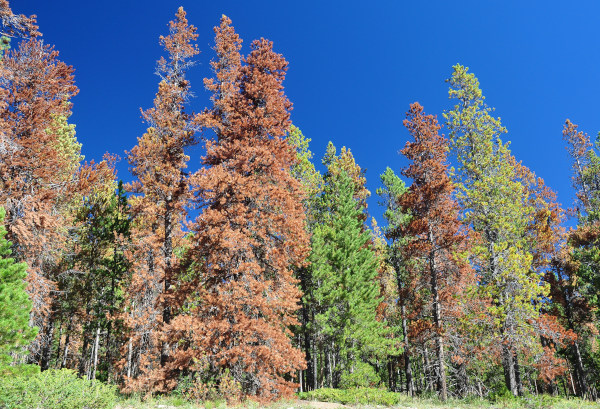
Fading or Discoloring Needles
Healthy green needles that turn yellowish, then rusty red. By the time an entire crown is red, the beetles have typically already exited the tree and moved to new hosts.
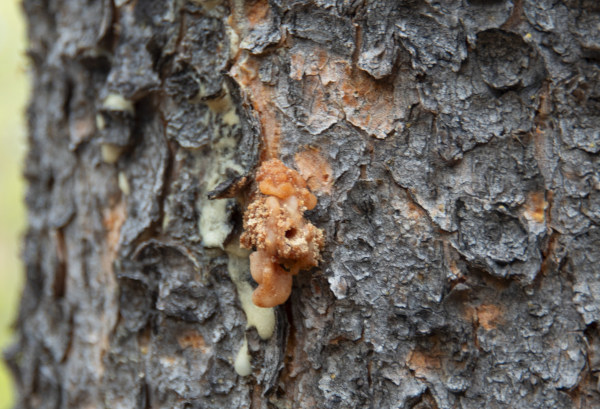
Pitch Tubes on the Trunk
Small, popcorn-shaped masses of resin on the bark surface. These form when the tree tries to "pitch out" boring beetles. Reddish-brown pitch tubes indicate a failed defense.
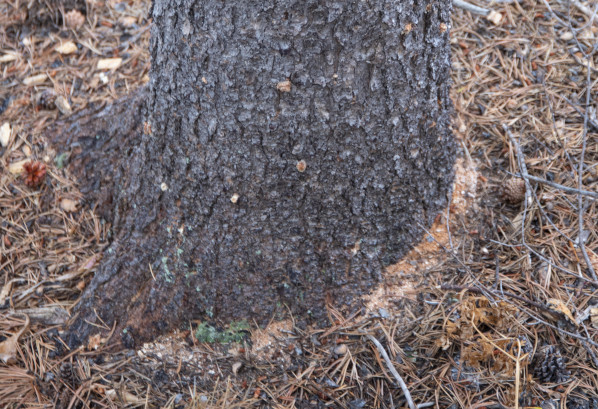
Boring Dust (Frass)
Fine, reddish-brown sawdust accumulating in bark crevices, around the base of the tree, and on spider webs nearby. This indicates active beetle tunneling beneath the bark.
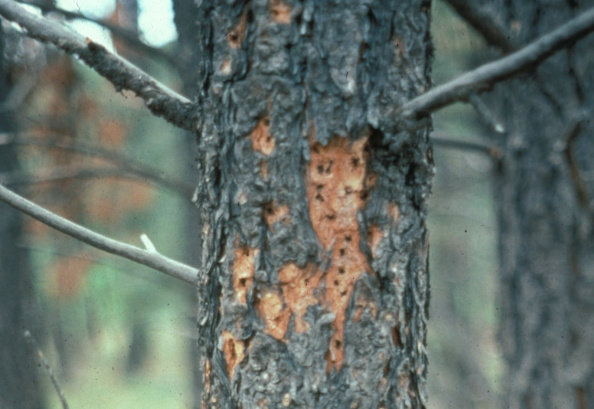
Woodpecker Activity
Heavy woodpecker feeding on trunk and branches strips bark as they search for beetle larvae. Large patches of light-colored, exposed wood are a telltale sign of severe infestation.
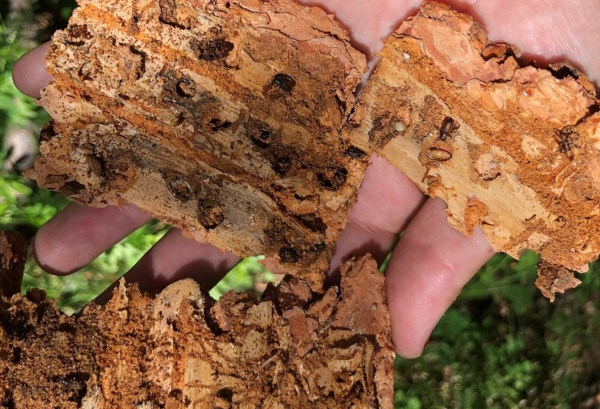
J-Shaped Galleries Under Bark
Peel back a small section of loose bark to reveal tunneling patterns. Mountain pine beetles create distinctive J- or Y-shaped egg galleries carved into the inner bark.
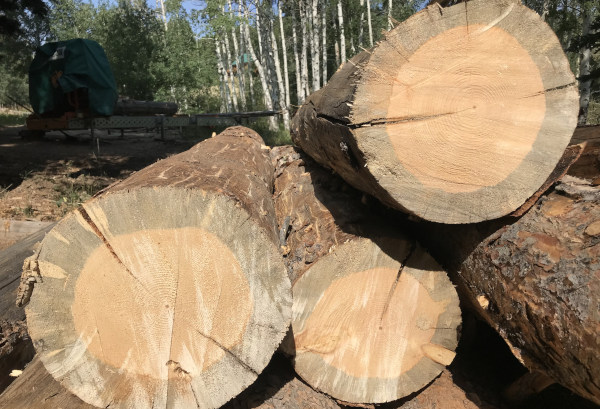
Blue Stain Fungus
Beetles carry blue stain fungus that blocks the tree's water-conducting tissues. Cross-cut sections of affected wood show distinctive blue-gray streaking through the sapwood.
Photos: Colorado State Forest Service
Nearby Front Range Communities
Castle Pines
Douglas County
Beetle Activity Documented
Castle Rock
Douglas County
Beetle Activity Documented
Larkspur
Douglas County
Beetle Activity Documented
Lone Tree
Douglas County
Beetle Activity Documented
Parker
Douglas County
Beetle Activity Documented
Sedalia
Douglas County
Beetle Activity Documented
Latest from the Blog
View All →
Colorado's 2026 Pine Beetle Response: Task Force, Funding, and What It Means for Homeowners
Governor Polis created a statewide task force, Jefferson County launched a $500K cost-share program, and the legislature is funding biological controls. Here's what Colorado is actually doing about the pine beetle outbreak — and what homeowners need to know.

Colorado's Ponderosa Mountain Pine Beetle Task Force: What It Is, Who's Behind It, and What It Means for the Front Range
Colorado's Ponderosa Mountain Pine Beetle Task Force was created to fight the expanding Front Range outbreak. Here's what the task force is doing and what it means for you.