
Pine Beetle Prevention in Parker, Colorado
Protect your trees from bark beetle infestations in Parker, Douglas County. Local prevention tips, risk assessment, and professional resources.
Elevation
5,869'
Population
62,704
County
Douglas
Primary Trees
Ponderosa Pine
CSFS Mountain Pine Beetle Activity — Douglas County
Documented
Active beetles in county
Adjacent
Nearby activity
Not Documented
No confirmed activity
Source: Colorado State Forest Service aerial surveys, 2024
Mountain Pine Beetle in Douglas County
Douglas County has elevated MPB infestation levels across its ponderosa pine forests, particularly along the Palmer Divide where Castle Rock, Castle Pines, and Larkspur are situated.
Douglas County Details
The Palmer Divide's ponderosa-dominated forests are a prime target for mountain pine beetles. Douglas County's rapid suburban growth has created extensive wildland-urban interface zones where residential properties border unthinned forest stands. The county forestry division provides site assessments and thinning recommendations.
Key Finding
Elevated infestation levels documented across county's Palmer Divide forests
Front Range Outbreak Trend
Acres of MPB-caused tree mortality, Front Range. Source: CSFS Aerial Surveys, 2020–2024
700K+
Acres of vulnerable pine along the Front Range
1,767%
Increase in affected acres, 2020–2024
Data sourced from Colorado State Forest Service aerial survey reports, forest health publications, and local reporting.
Pine Beetle Guide for Parker, Colorado
Parker is a thriving community of nearly 63,000 residents in northeastern Douglas County, situated at 5,869 feet along the transition zone where the Colorado Front Range foothills give way to the high plains. Originally a small agricultural town centered around the mainline railroad, Parker has transformed into one of the Denver metro area's most desirable suburbs. Its tree-lined neighborhoods — including Stonegate, Stroh Ranch, Canterberry, and the Pines — blend suburban convenience with a landscape still rooted in its Ponderosa Pine heritage. Parker's position at a slightly lower elevation than its neighbors to the south and west places it in a transitional zone for beetle activity, but the threat is far from negligible.
Pine Beetle Risk in Parker
Parker is classified as High risk for pine beetle activity, one step below the Critical designation held by nearby Castle Rock and Castle Pines. This High rating reflects Parker's somewhat lower elevation and the fact that its residential development pattern has naturally thinned pine stands in many areas. However, several factors keep Parker firmly in the danger zone.
Parker sits on the northern edge of the Palmer Divide, where elevations gradually descend toward the Cherry Creek drainage. The town's soils are a patchwork of sandy loam derived from the Dawson Arkose formation in the south and heavier clay soils in the northern and eastern sections. Ponderosa Pines thrive in the sandier southern soils but are more stressed in the clay-heavy areas where drainage is poor and root rot can weaken trees.
The Sulphur Gulch and Cherry Creek corridors running through Parker create natural pathways for beetle dispersal. Infested trees upstream in the Castle Rock and Castle Pines areas produce beetles that follow these drainages northward, arriving in Parker with each summer's flight season. Neighborhoods along these waterways — particularly Stonegate and Cottonwood — see higher beetle pressure than Parker's eastern subdivisions.
Parker's rapid growth since the 1990s has created a mosaic of mature Ponderosa stands interspersed with new construction. In older neighborhoods near Mainstreet and along Parker Road, Ponderosas dating back 60 to 80 years stand close together on small lots, creating localized pockets of high vulnerability. Meanwhile, newer developments often retained scattered specimen pines surrounded by irrigated turf — an arrangement that can actually help tree health if watering reaches the root zone.
The drought of 2020-2022 significantly stressed Parker's Ponderosa Pine population. Douglas County foresters documented a noticeable uptick in Ips beetle activity in Parker during 2021, particularly in the Stonegate and Canterberry neighborhoods where tree densities remain higher than average.
Prevention Tips for Parker Properties
Parker's transitional environment calls for a prevention strategy that addresses both the drought-and-beetle cycle and the ongoing impacts of development on tree health.
Soil-Type-Specific Watering: Parker spans two very different soil types, and a one-size approach fails. In the sandy Dawson Arkose soils south of Mainstreet, deep-water Ponderosas once monthly during dry periods using a soaker hose at the drip line for four to six hours. In the heavier clay soils north and east of town, switch to every six weeks with a slow-drip system running at a trickle for eight to ten hours — the clay needs time to absorb water without ponding. The Parker Water and Sanitation District permits supplemental tree watering during drought restrictions; verify their current guidelines each spring before setting up your watering schedule.
Protect Trees During Construction and Renovation: If you are building, adding a deck, or running utility lines on a Parker property with Ponderosas, fence each tree at the drip line before work begins. No equipment, materials storage, or foot traffic should occur inside that perimeter. Specify in contractor agreements that grade changes within 20 feet of any Ponderosa require arborist review. The investment in prevention during a $30,000 deck project is trivial compared to losing a mature Ponderosa worth $5,000 to $15,000 in property value two years later.
HOA-Level Forest Health Coordination: Pine beetles do not respect property lines, and Parker's tightly packed subdivisions mean your neighbor's infested tree threatens every pine on your lot. Stonegate, Stroh Ranch, and the Pinery HOAs have begun incorporating forest health into community planning. If your HOA has not addressed beetle mitigation, raise the issue at a board meeting — propose community-wide winter pruning standards, a coordinated dead tree removal timeline, and shared preventive treatment contracts that reduce per-tree costs through volume purchasing. Bring a few photos of beetle damage from Douglas County presentations to make the case tangible.
Dormant-Season-Only Pruning: The safe pruning window for Ponderosa Pine in Parker is November 1 through March 15. Pruning during warm months releases terpene volatiles that Ips beetles detect and follow from considerable distances. If storm damage requires emergency summer pruning, remove all cut material from the property within 24 hours and chip it immediately. Communicate this standard to your HOA and any contracted landscape companies — many commercial tree crews default to summer scheduling for efficiency, not biology.
Targeted Preventive Treatment: For specimen Ponderosas near your home — the trees that provide shade, privacy, and property value — annual preventive bark sprays applied between mid-April and late May provide reliable protection. Carbaryl and bifenthrin products are most commonly used in Parker. For trees too tall to spray effectively from the ground, discuss systemic trunk injection with a licensed arborist as an alternative, though this approach is newer and less proven against bark beetles than topical applications.
Local Resources
- Douglas County Forestry Division provides free on-site assessments for Parker homeowners, including beetle identification and treatment planning. They host annual spring workshops on beetle prevention, often held at the Parker library or community center.
- Parker Water and Sanitation District publishes seasonal watering guidelines that specifically address supplemental tree irrigation during drought restrictions. Their website includes a tree watering FAQ with Parker-specific soil and climate recommendations.
- Town of Parker Open Space and Trails Division actively manages beetle mitigation on public open space parcels adjacent to residential areas, including the Sulphur Gulch corridor. Contact them about beetle conditions on open space near your neighborhood.
- Douglas County Extension Office (CSU Extension) provides free diagnostic services for tree health issues. You can bring bark samples, branch sections, or photos to their office for beetle species identification and management advice.
- Parker Area Fire Protection District offers defensible space consultations that include beetle-killed tree removal guidance, particularly relevant for properties along the western open-space edges of Parker's subdivisions.
Nearby Affected Areas
Parker's beetle risk is shaped by its connections to neighboring communities along the Palmer Divide. To the south, Castle Rock and Castle Pines carry Critical risk ratings, and beetles from those higher-elevation forests regularly disperse northward into Parker. Highlands Ranch to the west shares Parker's High risk designation and similar transitional conditions. To the southwest, Lone Tree represents the edge of significant beetle pressure, while Larkspur to the south — deep in the Palmer Divide pine belt — serves as a significant source of mountain pine beetles during outbreak years. Homeowners in Parker's southern neighborhoods should pay particular attention to beetle reports from these adjacent communities.
Common Pine Beetle Species in Colorado
Three bark beetle species pose the greatest threat to pine trees in Parker and across Colorado's Front Range.
Mountain Pine Beetle
Dendroctonus ponderosae
The primary killer of Ponderosa and Lodgepole pines along the Front Range. Adults are black, about the size of a grain of rice (5mm). They use aggregation pheromones to coordinate mass attacks that overwhelm a tree's pitch defenses.
- ● Targets trees 8"+ diameter
- ● One generation per year (July–August flight)
- ● Carries blue stain fungus that blocks water transport
- ● Creates J-shaped egg galleries under bark
Ips Engraver Beetle
Ips pini
A smaller, opportunistic beetle that exploits any weakness: drought stress, pruning wounds, fresh slash piles, or construction damage to roots. Less dramatic than MPB but persistent and hard to prevent entirely.
- ● Attacks trees of any size, including limbs
- ● 2–3 generations per year (April–October)
- ● Creates Y-shaped egg galleries under bark
- ● Often the first beetle to attack stressed trees
Red Turpentine Beetle
Dendroctonus valens
The largest bark beetle in North America (up to 10mm). Typically attacks the lower trunk of weakened or injured trees. Rarely kills trees on its own but signals stress that can attract MPB and Ips beetles.
- ● Attacks lower 6 feet of trunk
- ● Produces large, quarter-sized pitch tubes
- ● Indicator species for tree stress
- ● Often found after construction or root damage
Species data: Colorado State Forest Service, USDA Forest Service
Signs of Pine Beetle Infestation
Knowing what to look for is the first step to protecting your Parker property. Here are the key warning signs every homeowner should monitor.
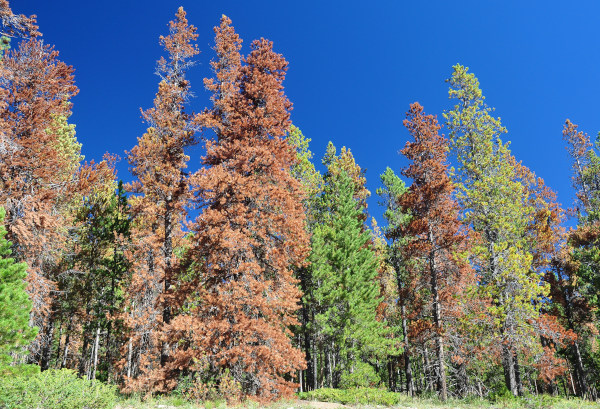
Fading or Discoloring Needles
Healthy green needles that turn yellowish, then rusty red. By the time an entire crown is red, the beetles have typically already exited the tree and moved to new hosts.
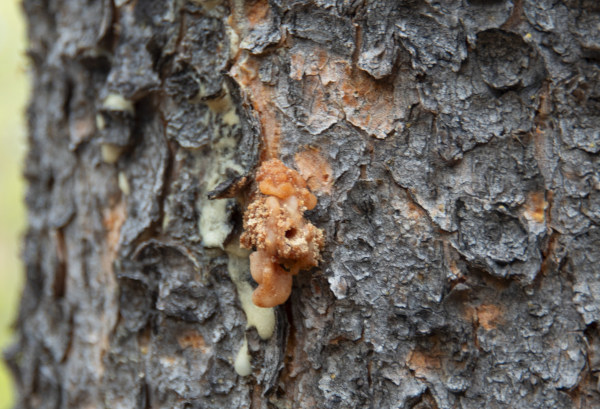
Pitch Tubes on the Trunk
Small, popcorn-shaped masses of resin on the bark surface. These form when the tree tries to "pitch out" boring beetles. Reddish-brown pitch tubes indicate a failed defense.
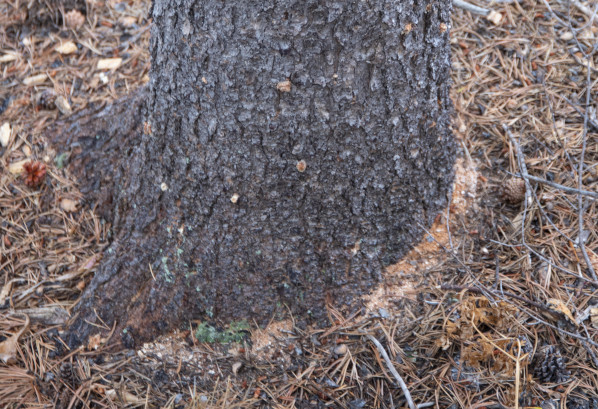
Boring Dust (Frass)
Fine, reddish-brown sawdust accumulating in bark crevices, around the base of the tree, and on spider webs nearby. This indicates active beetle tunneling beneath the bark.
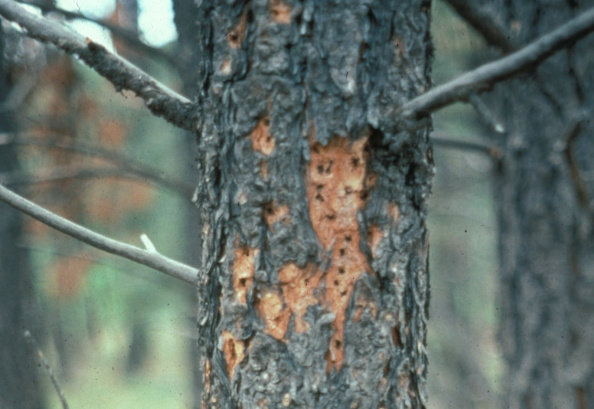
Woodpecker Activity
Heavy woodpecker feeding on trunk and branches strips bark as they search for beetle larvae. Large patches of light-colored, exposed wood are a telltale sign of severe infestation.
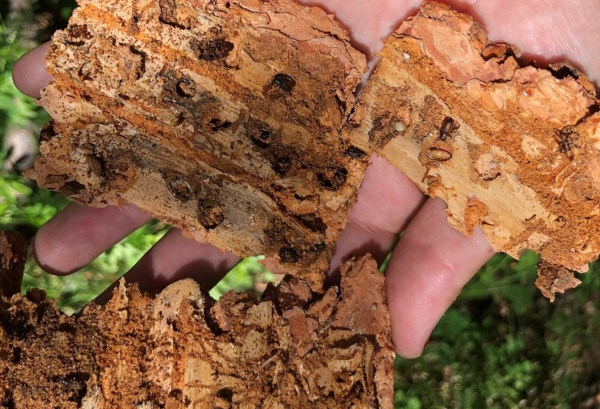
J-Shaped Galleries Under Bark
Peel back a small section of loose bark to reveal tunneling patterns. Mountain pine beetles create distinctive J- or Y-shaped egg galleries carved into the inner bark.
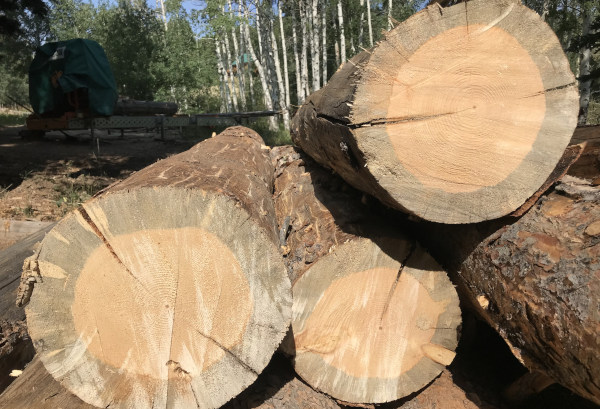
Blue Stain Fungus
Beetles carry blue stain fungus that blocks the tree's water-conducting tissues. Cross-cut sections of affected wood show distinctive blue-gray streaking through the sapwood.
Photos: Colorado State Forest Service
Nearby Front Range Communities
Castle Pines
Douglas County
Beetle Activity Documented
Castle Rock
Douglas County
Beetle Activity Documented
Highlands Ranch
Douglas County
Beetle Activity Documented
Larkspur
Douglas County
Beetle Activity Documented
Lone Tree
Douglas County
Beetle Activity Documented
Sedalia
Douglas County
Beetle Activity Documented
Latest from the Blog
View All →
Colorado's 2026 Pine Beetle Response: Task Force, Funding, and What It Means for Homeowners
Governor Polis created a statewide task force, Jefferson County launched a $500K cost-share program, and the legislature is funding biological controls. Here's what Colorado is actually doing about the pine beetle outbreak — and what homeowners need to know.

Colorado's Ponderosa Mountain Pine Beetle Task Force: What It Is, Who's Behind It, and What It Means for the Front Range
Colorado's Ponderosa Mountain Pine Beetle Task Force was created to fight the expanding Front Range outbreak. Here's what the task force is doing and what it means for you.