
Pine Beetle Prevention in Castle Rock, Colorado
Protect your trees from bark beetle infestations in Castle Rock, Douglas County. Local prevention tips, risk assessment, and professional resources.
Elevation
6,202'
Population
78,195
County
Douglas
Primary Trees
Ponderosa Pine
CSFS Mountain Pine Beetle Activity — Douglas County
Documented
Active beetles in county
Adjacent
Nearby activity
Not Documented
No confirmed activity
Source: Colorado State Forest Service aerial surveys, 2024
Mountain Pine Beetle in Douglas County
Douglas County has elevated MPB infestation levels across its ponderosa pine forests, particularly along the Palmer Divide where Castle Rock, Castle Pines, and Larkspur are situated.
Douglas County Details
The Palmer Divide's ponderosa-dominated forests are a prime target for mountain pine beetles. Douglas County's rapid suburban growth has created extensive wildland-urban interface zones where residential properties border unthinned forest stands. The county forestry division provides site assessments and thinning recommendations.
Key Finding
Elevated infestation levels documented across county's Palmer Divide forests
Front Range Outbreak Trend
Acres of MPB-caused tree mortality, Front Range. Source: CSFS Aerial Surveys, 2020–2024
700K+
Acres of vulnerable pine along the Front Range
1,767%
Increase in affected acres, 2020–2024
Data sourced from Colorado State Forest Service aerial survey reports, forest health publications, and local reporting.
Pine Beetle Guide for Castle Rock, Colorado
Castle Rock sits at the geographic heart of Douglas County, a rapidly growing community of over 78,000 residents perched at 6,202 feet along the Palmer Divide. The town takes its name from the prominent castle-shaped butte that rises above downtown, a landmark visible for miles across the Front Range. Surrounding the town center, neighborhoods like The Meadows, Castlewood Ranch, and Crystal Valley Ranch sprawl outward into rolling terrain dotted with mature Ponderosa Pine stands. These native pines define Castle Rock's semi-rural character and draw homebuyers seeking a mountain-adjacent lifestyle between Denver and Colorado Springs. Unfortunately, those same beloved Ponderosa Pines face a growing and serious threat from bark beetles that have intensified their activity across the Palmer Divide in recent years.
Pine Beetle Risk in Castle Rock
Castle Rock carries a Critical pine beetle risk designation, and the reasons are deeply tied to the town's geography and climate. Sitting squarely on the Palmer Divide — the elevated ridge separating the South Platte and Arkansas River watersheds — Castle Rock experiences weather patterns distinct from both Denver and Colorado Springs. The Divide generates its own convective storms in summer, but overall precipitation has trended downward over the past decade, placing chronic drought stress on Ponderosa Pines throughout the area.
At 6,202 feet, Castle Rock occupies the elevation sweet spot where mountain pine beetles (Dendroctonus ponderosae) and Ips engraver beetles overlap in activity. The town's soils are predominantly a mix of Dawson Arkose sandstone derivatives and weathered granite — porous, well-drained substrates that shed moisture quickly and leave tree root systems competing for limited groundwater during dry spells. Stressed trees produce less defensive pitch, making them vulnerable to beetle colonization.
The western edges of Castle Rock, particularly neighborhoods along Crowfoot Valley Road and near Dawson Butte, border open space with dense, unthinned Ponderosa stands. These wildland-urban interface zones have seen documented beetle activity since the early 2010s, with kill rates accelerating after the drought years of 2018 and 2020. Warmer winters — Castle Rock has recorded fewer sustained sub-zero cold snaps in the last decade — allow beetle larvae to survive through winter at higher rates, compounding the problem year over year.
Prevention Tips for Castle Rock Properties
Castle Rock straddles two distinct environments — semi-rural western edges bordering open space and more suburban eastern developments — and prevention strategies should reflect where your property falls on that spectrum.
Supplemental Watering Matched to Castle Rock's Soils: The town's well-drained Dawson Arkose soils lose moisture rapidly, meaning surface watering evaporates before reaching deep root zones. Use a deep-root watering probe or needle injector placed at the drip line — not at the trunk base — to deliver water directly to the root zone 12 to 18 inches below grade. During dry periods from October through May, a single deep soak monthly makes a measurable difference in pitch production the following summer. Castle Rock Water permits deep-root tree watering even during drought restrictions, recognizing that tree health is both an aesthetic and fire safety priority.
Neighborhood-Scale Coordination for Open Space Edges: Properties along Crowfoot Valley Road, Dawson Butte Open Space, and the Ridgeline trail system face beetle pressure from adjacent unmanaged stands. Individual property treatment is necessary but insufficient — coordinate with your HOA and adjacent property owners to address beetle-susceptible trees across property lines simultaneously. A single untreated lot in a row of treated ones negates much of the investment. The Douglas County Forestry Division can facilitate neighborhood-level planning sessions.
Construction-Era Tree Damage Awareness: Many Castle Rock developments built in the 2000s and 2010s preserved existing Ponderosas during construction but inadvertently damaged root zones with trenching, soil compaction, and grade changes. Trees that appeared healthy at move-in may now be showing delayed decline — thinning crowns, reduced needle length, and stress that makes them beetle targets. If your home is in a development less than 15 years old and your pines look progressively worse, have a certified arborist assess root zone integrity before assuming beetle activity.
Targeted Preventive Treatment for Specimen Trees: Rather than blanket-spraying every pine on your lot, focus preventive bark treatments on the three to five highest-value trees closest to your home. Apply carbaryl-based products between mid-April and early June, ensuring full trunk coverage from ground to the base of the live crown. Systemic trunk injections using emamectin benzoate are gaining use in Castle Rock for trees too tall to spray effectively, though the research on their bark beetle efficacy in Ponderosa Pine is still developing. Budget approximately $10 to $15 per diameter inch for professional preventive spraying.
Firewood Hygiene: Castle Rock's suburban lots often include firewood stacks near back porches and fire pits. Fresh-cut pine firewood is a beetle incubator — Ips beetles can colonize a slash pile within 48 hours during warm months. If you store pine firewood, debark it or cover the stack tightly with clear plastic sheeting from April through September to solar-heat and kill emerging beetles. Better practice is to burn or remove all pine firewood by April 1 each year.
Local Resources
- Douglas County Forestry Division provides free on-site property assessments for beetle concerns, including tree-by-tree risk evaluation and treatment recommendations. They also run annual spring neighborhood workshops along the Palmer Divide corridor — Castle Rock sessions typically fill up quickly, so register early through the county website.
- Castle Rock Fire and Rescue operates a wildfire mitigation program covering the wildland-urban interface zones along the town's western and southern boundaries. Their defensible space evaluations include dead and beetle-killed tree removal prioritization.
- Castle Rock Water publishes specific guidelines for tree watering during drought restrictions, available on their website and at their office. Their irrigation exception policy recognizes deep-root tree watering as a conservation-compatible activity.
- Castlewood Canyon State Park staff monitor beetle conditions within the park, and their observations provide early warning for adjacent Castle Rock neighborhoods. Contact the park office for current conditions if you live near the park boundary.
- Douglas County Master Gardeners (Colorado State University Extension) host drop-in plant clinics at the Castle Rock library and fairgrounds where you can bring bark samples, photos, or branches for beetle identification at no cost.
Nearby Affected Areas
Pine beetle activity in Castle Rock does not exist in isolation. The town's beetle pressure is connected to broader infestations across the Palmer Divide corridor. To the south, Larkspur and Sedalia have experienced severe Ponderosa Pine losses in their more heavily forested landscapes. Castle Pines, immediately to the north, faces similar Critical-level risk in its dense residential pine forests. Parker to the northeast and Highlands Ranch to the north represent the transition zone where beetle risk shifts from Critical to High as elevation decreases and development density increases. Monitoring beetle movement across these connected communities is essential for understanding and responding to the regional threat.
Common Pine Beetle Species in Colorado
Three bark beetle species pose the greatest threat to pine trees in Castle Rock and across Colorado's Front Range.
Mountain Pine Beetle
Dendroctonus ponderosae
The primary killer of Ponderosa and Lodgepole pines along the Front Range. Adults are black, about the size of a grain of rice (5mm). They use aggregation pheromones to coordinate mass attacks that overwhelm a tree's pitch defenses.
- ● Targets trees 8"+ diameter
- ● One generation per year (July–August flight)
- ● Carries blue stain fungus that blocks water transport
- ● Creates J-shaped egg galleries under bark
Ips Engraver Beetle
Ips pini
A smaller, opportunistic beetle that exploits any weakness: drought stress, pruning wounds, fresh slash piles, or construction damage to roots. Less dramatic than MPB but persistent and hard to prevent entirely.
- ● Attacks trees of any size, including limbs
- ● 2–3 generations per year (April–October)
- ● Creates Y-shaped egg galleries under bark
- ● Often the first beetle to attack stressed trees
Red Turpentine Beetle
Dendroctonus valens
The largest bark beetle in North America (up to 10mm). Typically attacks the lower trunk of weakened or injured trees. Rarely kills trees on its own but signals stress that can attract MPB and Ips beetles.
- ● Attacks lower 6 feet of trunk
- ● Produces large, quarter-sized pitch tubes
- ● Indicator species for tree stress
- ● Often found after construction or root damage
Species data: Colorado State Forest Service, USDA Forest Service
Signs of Pine Beetle Infestation
Knowing what to look for is the first step to protecting your Castle Rock property. Here are the key warning signs every homeowner should monitor.
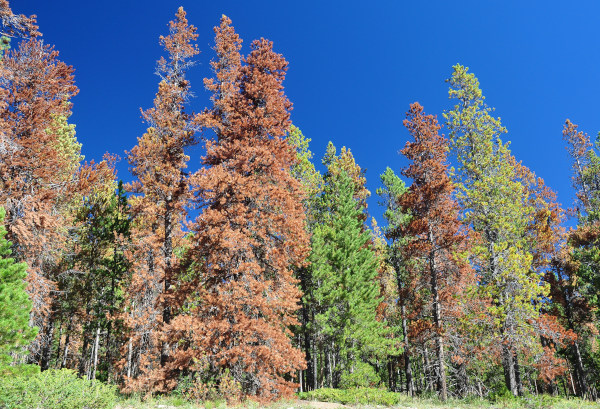
Fading or Discoloring Needles
Healthy green needles that turn yellowish, then rusty red. By the time an entire crown is red, the beetles have typically already exited the tree and moved to new hosts.
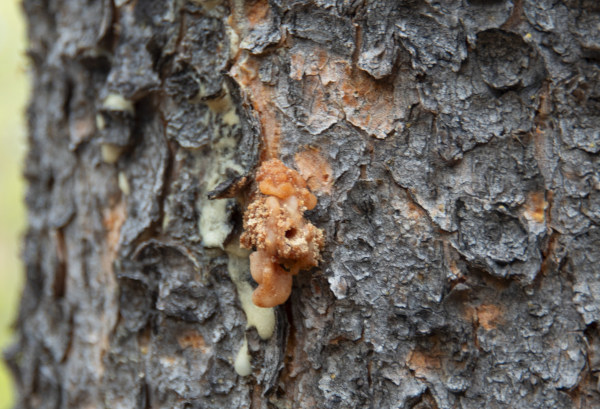
Pitch Tubes on the Trunk
Small, popcorn-shaped masses of resin on the bark surface. These form when the tree tries to "pitch out" boring beetles. Reddish-brown pitch tubes indicate a failed defense.
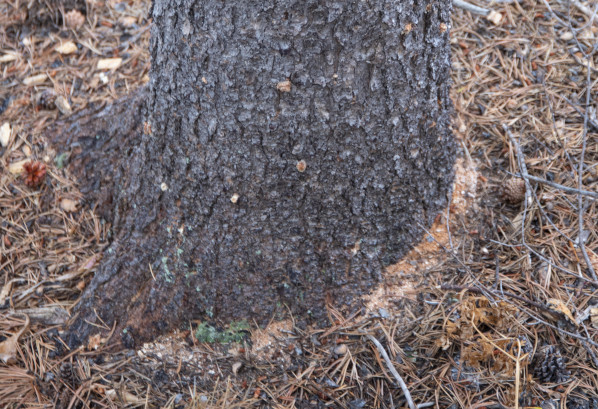
Boring Dust (Frass)
Fine, reddish-brown sawdust accumulating in bark crevices, around the base of the tree, and on spider webs nearby. This indicates active beetle tunneling beneath the bark.
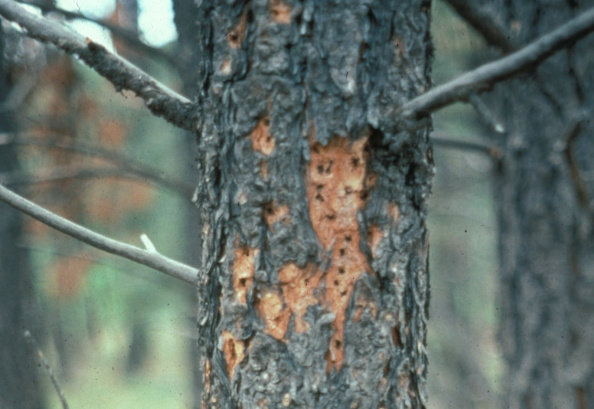
Woodpecker Activity
Heavy woodpecker feeding on trunk and branches strips bark as they search for beetle larvae. Large patches of light-colored, exposed wood are a telltale sign of severe infestation.
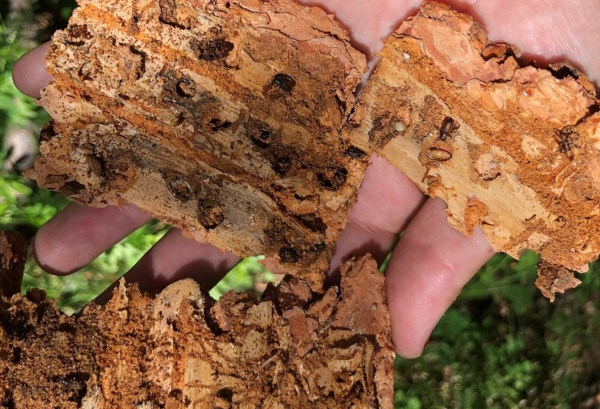
J-Shaped Galleries Under Bark
Peel back a small section of loose bark to reveal tunneling patterns. Mountain pine beetles create distinctive J- or Y-shaped egg galleries carved into the inner bark.
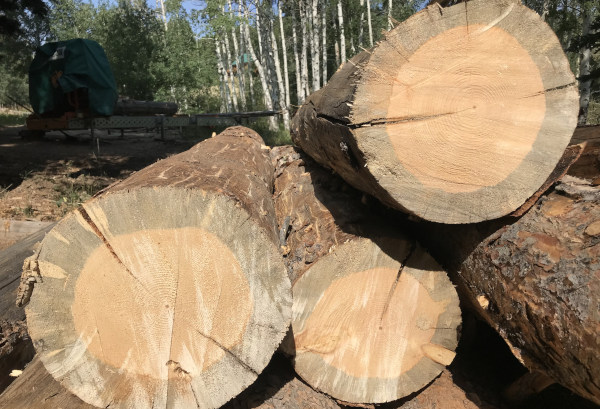
Blue Stain Fungus
Beetles carry blue stain fungus that blocks the tree's water-conducting tissues. Cross-cut sections of affected wood show distinctive blue-gray streaking through the sapwood.
Photos: Colorado State Forest Service
Nearby Front Range Communities
Castle Pines
Douglas County
Beetle Activity Documented
Highlands Ranch
Douglas County
Beetle Activity Documented
Larkspur
Douglas County
Beetle Activity Documented
Lone Tree
Douglas County
Beetle Activity Documented
Parker
Douglas County
Beetle Activity Documented
Sedalia
Douglas County
Beetle Activity Documented
Latest from the Blog
View All →
Colorado's 2026 Pine Beetle Response: Task Force, Funding, and What It Means for Homeowners
Governor Polis created a statewide task force, Jefferson County launched a $500K cost-share program, and the legislature is funding biological controls. Here's what Colorado is actually doing about the pine beetle outbreak — and what homeowners need to know.

Colorado's Ponderosa Mountain Pine Beetle Task Force: What It Is, Who's Behind It, and What It Means for the Front Range
Colorado's Ponderosa Mountain Pine Beetle Task Force was created to fight the expanding Front Range outbreak. Here's what the task force is doing and what it means for you.