
Pine Beetle Prevention in Castle Pines, Colorado
Protect your trees from bark beetle infestations in Castle Pines, Douglas County. Local prevention tips, risk assessment, and professional resources.
Elevation
6,600'
Population
11,460
County
Douglas
Primary Trees
Ponderosa Pine
CSFS Mountain Pine Beetle Activity — Douglas County
Documented
Active beetles in county
Adjacent
Nearby activity
Not Documented
No confirmed activity
Source: Colorado State Forest Service aerial surveys, 2024
Mountain Pine Beetle in Douglas County
Douglas County has elevated MPB infestation levels across its ponderosa pine forests, particularly along the Palmer Divide where Castle Rock, Castle Pines, and Larkspur are situated.
Douglas County Details
The Palmer Divide's ponderosa-dominated forests are a prime target for mountain pine beetles. Douglas County's rapid suburban growth has created extensive wildland-urban interface zones where residential properties border unthinned forest stands. The county forestry division provides site assessments and thinning recommendations.
Key Finding
Elevated infestation levels documented across county's Palmer Divide forests
Front Range Outbreak Trend
Acres of MPB-caused tree mortality, Front Range. Source: CSFS Aerial Surveys, 2020–2024
700K+
Acres of vulnerable pine along the Front Range
1,767%
Increase in affected acres, 2020–2024
Data sourced from Colorado State Forest Service aerial survey reports, forest health publications, and local reporting.
Pine Beetle Guide for Castle Pines, Colorado
Castle Pines is an affluent community of approximately 11,460 residents nestled into the foothills terrain of southern Douglas County at an elevation of 6,600 feet. Split between the gated Castle Pines Village and the newer Castle Pines North developments, the community is defined by its integration with the surrounding Ponderosa Pine forest. Homes here were deliberately sited among mature pine stands, with covenants requiring preservation of native trees during construction. The result is a stunningly wooded residential landscape — and one that is acutely vulnerable to pine beetle outbreaks. The dense canopy that gives Castle Pines its exclusivity and property values also creates ideal conditions for bark beetle proliferation.
Pine Beetle Risk in Castle Pines
Castle Pines holds a Critical pine beetle risk rating, the highest designation on the Front Range risk scale. Several compounding factors drive this elevated risk.
The community's 6,600-foot elevation places it firmly within the optimal range for mountain pine beetle activity, which peaks between 6,000 and 9,000 feet along Colorado's Front Range. Castle Pines Village, the original gated community, was developed in the 1980s within a mature Ponderosa Pine forest, and many of those trees are now 80 to 120 years old — the preferred age and size class for mountain pine beetle attack. Old-growth and mature Ponderosas with thick bark and large diameters produce the phloem resources beetles need to complete their reproductive cycle.
The soils beneath Castle Pines are derived from the Dawson Arkose formation — coarse, sandy, and exceptionally well-drained. While these soils support Ponderosa Pine growth, they retain very little moisture during dry periods. The community sits on a south-facing slope aspect in many areas, which increases solar exposure, accelerates evapotranspiration, and compounds drought stress on trees.
Perhaps most critically, Castle Pines has some of the densest residential pine canopy on the entire Front Range. The original Castle Pines Village development preserved trees at near-natural forest densities — often with canopy closure exceeding 60 percent. Natural Ponderosa Pine stands in Colorado evolved with fire cycles that thinned stands every 15 to 30 years. Without that thinning, trees in Castle Pines compete intensely for water, leaving all of them more susceptible to beetle attack. The community's HOA tree preservation rules, while well-intentioned, have historically made proactive thinning difficult to implement at the scale needed.
The 2012 and 2020 drought cycles hit Castle Pines hard. Residents reported significant Ponderosa die-off in both periods, with beetle-killed trees concentrated along Happy Canyon Road and in the older sections of the Village near the golf course. The Douglas County Forestry Division documented over 200 beetle-killed Ponderosas in Castle Pines during the 2020-2021 assessment period alone.
Prevention Tips for Castle Pines Properties
Prevention in Castle Pines requires navigating the community's unique tension between tree preservation covenants and the biological reality that overcrowded forests are dying forests.
Navigate HOA Thinning Through Forest Health Framing: Castle Pines Village and Castle Pines North both have architectural and landscape committees that regulate tree removal. Rather than requesting generic "tree removal," submit thinning proposals framed as forest health management plans with supporting documentation from a certified arborist or the Douglas County Forestry Division. Reference the community's documented beetle losses and present thinning as property value protection. The Castle Pines Metro District has begun incorporating forest health language into community planning, creating precedent for approval. A well-documented proposal citing beetle risk and wildfire mitigation typically receives faster committee approval than a generic removal request.
Deep-Root Watering on Sandy Soils: Castle Pines' Dawson Arkose soils drain so rapidly that surface irrigation barely reaches Ponderosa Pine roots. Install a dedicated deep-root watering system for specimen trees within 50 feet of your home — a deep-root irrigator probe or soaker hose placed at the drip line and run slowly for four to six hours delivers water to the 12-to-24-inch depth where feeder roots concentrate. Water during the dormant season from October through April as well, because winter drought stress is the factor that determines whether a tree can produce enough defensive pitch during the following summer's beetle flight season. Aim for one thorough soak per month during dry periods.
Slash Management After Any Tree Work: In Castle Pines' continuous forest, slash left on-site after thinning or pruning becomes a beetle incubator within days during warm months. Remove all pine slash from the property immediately after cutting. Do not chip and leave pine material on-site between April and October — the fresh chips release terpenes that attract Ips beetles. The Douglas County slash collection program operates annually in spring; time your thinning work to coincide with collection dates so material can be removed promptly.
Preventive Bark Sprays for Irreplaceable Specimens: For the handful of truly irreplaceable Ponderosas closest to your home — the ones that define your lot's character and shade your living spaces — annual preventive spraying with carbaryl (Sevin SL) or bifenthrin provides the most reliable individual tree protection available. Spray timing in Castle Pines should target late April to mid-May, before mountain pine beetle flight begins. The spray must coat the full trunk circumference from ground level to the base of the live crown. Hire a licensed applicator experienced with Castle Pines' steep terrain and tall trees, as inadequate coverage on the upper trunk leaves a gap beetles readily exploit.
Basal Area Density Targets: Work with a professional forester to measure your property's current stand density in basal area per acre — a metric that accounts for both the number and size of trees. Beetle-resistant Ponderosa Pine stands at Castle Pines' elevation should carry approximately 60 to 80 square feet of basal area per acre. Many Castle Pines properties exceed 120 square feet per acre. Reducing to the target range means removing roughly 40 to 50 percent of existing stems, prioritizing removal of suppressed, damaged, and small-diameter trees while retaining the largest, most vigorous individuals that have the best chance of surviving beetle pressure.
Local Resources
- Douglas County Forestry Division offers free property assessments and maintains a list of certified arborists experienced with beetle management in the Castle Pines area. Their foresters will walk your property and provide a written report with prioritized recommendations.
- Castle Pines Metropolitan District coordinates community-wide forestry initiatives and can facilitate conversations between property owners and HOA boards about forest health policy changes. Contact them for information on upcoming community thinning or treatment programs.
- Castle Pines Village HOA and Castle Pines North HOA landscape committees handle tree removal permitting. Engage them early — before you have a beetle emergency — to establish what level of proactive thinning they will approve.
- Castlewood Canyon State Park (adjacent to Castle Pines) conducts its own beetle monitoring on park lands. Their ranger staff can share observations about beetle pressure trends that forecast conditions on nearby residential properties.
- Colorado State Forest Service Golden District office provides technical guidance and can assist with developing a forest management plan for larger Castle Pines properties. They also administer cost-sharing grants that can offset thinning expenses.
Nearby Affected Areas
Castle Pines is surrounded by communities experiencing similar or elevated beetle pressure. Directly to the south, Castle Rock shares the same Critical risk profile and similar forest composition along the Palmer Divide. Sedalia and Larkspur to the southwest, with their more rural landscapes and proximity to Pike National Forest, serve as source populations for beetles that drift into Castle Pines. To the north, Highlands Ranch and Lone Tree have lower beetle risk due to reduced elevation and tree density, but they are not immune — beetles moving downslope from Castle Pines have been documented in the southern reaches of both communities.
Common Pine Beetle Species in Colorado
Three bark beetle species pose the greatest threat to pine trees in Castle Pines and across Colorado's Front Range.
Mountain Pine Beetle
Dendroctonus ponderosae
The primary killer of Ponderosa and Lodgepole pines along the Front Range. Adults are black, about the size of a grain of rice (5mm). They use aggregation pheromones to coordinate mass attacks that overwhelm a tree's pitch defenses.
- ● Targets trees 8"+ diameter
- ● One generation per year (July–August flight)
- ● Carries blue stain fungus that blocks water transport
- ● Creates J-shaped egg galleries under bark
Ips Engraver Beetle
Ips pini
A smaller, opportunistic beetle that exploits any weakness: drought stress, pruning wounds, fresh slash piles, or construction damage to roots. Less dramatic than MPB but persistent and hard to prevent entirely.
- ● Attacks trees of any size, including limbs
- ● 2–3 generations per year (April–October)
- ● Creates Y-shaped egg galleries under bark
- ● Often the first beetle to attack stressed trees
Red Turpentine Beetle
Dendroctonus valens
The largest bark beetle in North America (up to 10mm). Typically attacks the lower trunk of weakened or injured trees. Rarely kills trees on its own but signals stress that can attract MPB and Ips beetles.
- ● Attacks lower 6 feet of trunk
- ● Produces large, quarter-sized pitch tubes
- ● Indicator species for tree stress
- ● Often found after construction or root damage
Species data: Colorado State Forest Service, USDA Forest Service
Signs of Pine Beetle Infestation
Knowing what to look for is the first step to protecting your Castle Pines property. Here are the key warning signs every homeowner should monitor.
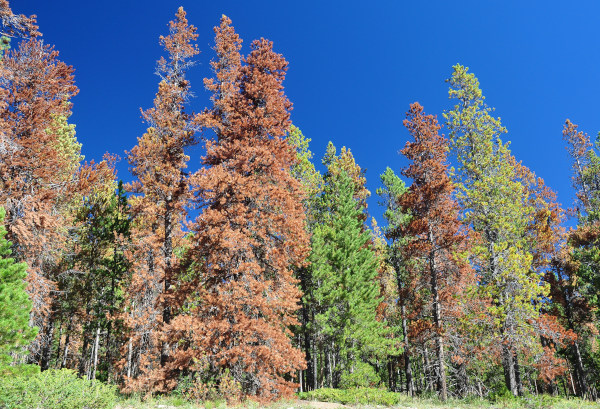
Fading or Discoloring Needles
Healthy green needles that turn yellowish, then rusty red. By the time an entire crown is red, the beetles have typically already exited the tree and moved to new hosts.
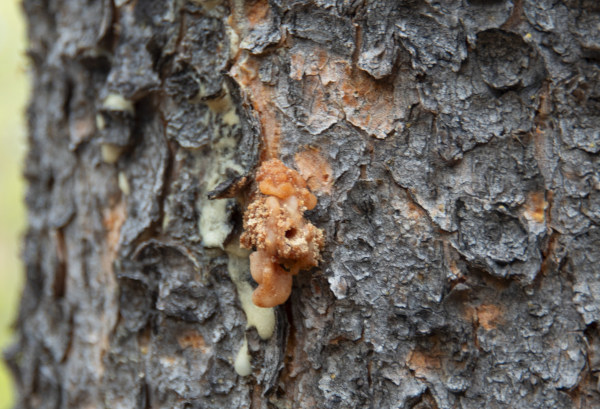
Pitch Tubes on the Trunk
Small, popcorn-shaped masses of resin on the bark surface. These form when the tree tries to "pitch out" boring beetles. Reddish-brown pitch tubes indicate a failed defense.
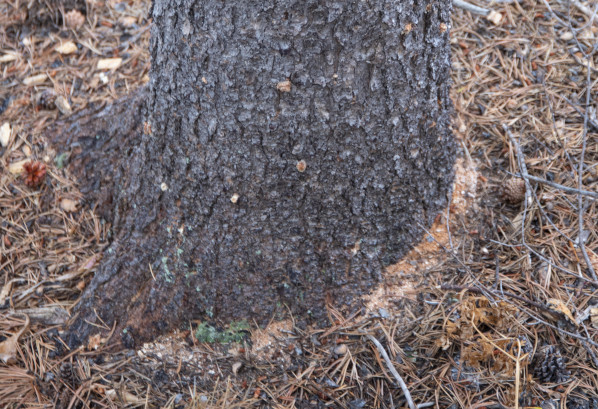
Boring Dust (Frass)
Fine, reddish-brown sawdust accumulating in bark crevices, around the base of the tree, and on spider webs nearby. This indicates active beetle tunneling beneath the bark.
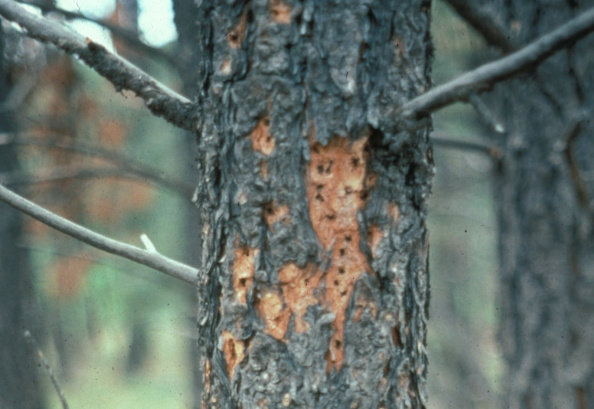
Woodpecker Activity
Heavy woodpecker feeding on trunk and branches strips bark as they search for beetle larvae. Large patches of light-colored, exposed wood are a telltale sign of severe infestation.
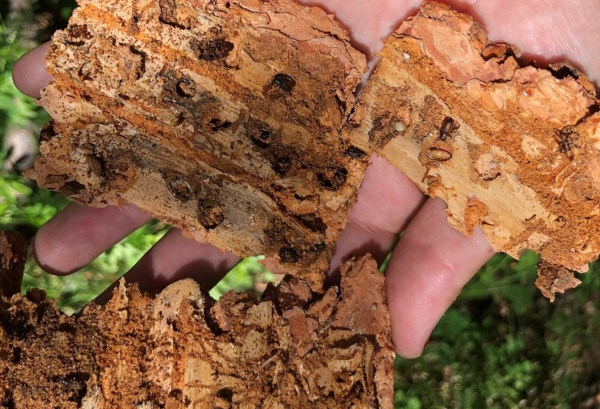
J-Shaped Galleries Under Bark
Peel back a small section of loose bark to reveal tunneling patterns. Mountain pine beetles create distinctive J- or Y-shaped egg galleries carved into the inner bark.
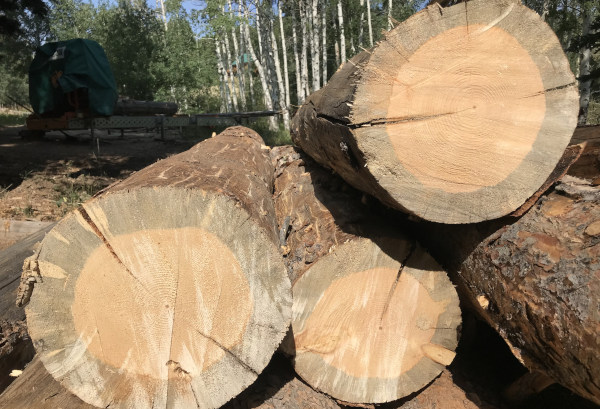
Blue Stain Fungus
Beetles carry blue stain fungus that blocks the tree's water-conducting tissues. Cross-cut sections of affected wood show distinctive blue-gray streaking through the sapwood.
Photos: Colorado State Forest Service
Nearby Front Range Communities
Castle Rock
Douglas County
Beetle Activity Documented
Highlands Ranch
Douglas County
Beetle Activity Documented
Larkspur
Douglas County
Beetle Activity Documented
Lone Tree
Douglas County
Beetle Activity Documented
Parker
Douglas County
Beetle Activity Documented
Sedalia
Douglas County
Beetle Activity Documented
Latest from the Blog
View All →
Colorado's 2026 Pine Beetle Response: Task Force, Funding, and What It Means for Homeowners
Governor Polis created a statewide task force, Jefferson County launched a $500K cost-share program, and the legislature is funding biological controls. Here's what Colorado is actually doing about the pine beetle outbreak — and what homeowners need to know.

Colorado's Ponderosa Mountain Pine Beetle Task Force: What It Is, Who's Behind It, and What It Means for the Front Range
Colorado's Ponderosa Mountain Pine Beetle Task Force was created to fight the expanding Front Range outbreak. Here's what the task force is doing and what it means for you.