
Pine Beetle Prevention in Larkspur, Colorado
Protect your trees from bark beetle infestations in Larkspur, Douglas County. Local prevention tips, risk assessment, and professional resources.
Elevation
6,696'
Population
250
County
Douglas
Primary Trees
Ponderosa Pine
CSFS Mountain Pine Beetle Activity — Douglas County
Documented
Active beetles in county
Adjacent
Nearby activity
Not Documented
No confirmed activity
Source: Colorado State Forest Service aerial surveys, 2024
Mountain Pine Beetle in Douglas County
Douglas County has elevated MPB infestation levels across its ponderosa pine forests, particularly along the Palmer Divide where Castle Rock, Castle Pines, and Larkspur are situated.
Douglas County Details
The Palmer Divide's ponderosa-dominated forests are a prime target for mountain pine beetles. Douglas County's rapid suburban growth has created extensive wildland-urban interface zones where residential properties border unthinned forest stands. The county forestry division provides site assessments and thinning recommendations.
Key Finding
Elevated infestation levels documented across county's Palmer Divide forests
Front Range Outbreak Trend
Acres of MPB-caused tree mortality, Front Range. Source: CSFS Aerial Surveys, 2020–2024
700K+
Acres of vulnerable pine along the Front Range
1,767%
Increase in affected acres, 2020–2024
Data sourced from Colorado State Forest Service aerial survey reports, forest health publications, and local reporting.
Pine Beetle Guide for Larkspur, Colorado
Larkspur is a small, unincorporated community of roughly 250 residents tucked into a narrow valley along the Palmer Divide at 6,696 feet in southern Douglas County. Straddling Interstate 25 between Castle Rock and Monument, Larkspur occupies one of the most densely forested stretches of the Front Range corridor. The surrounding hillsides are blanketed in mature Ponderosa Pine, with stands extending unbroken into Pike National Forest to the west. Larkspur's identity is inseparable from its forest setting — the annual Renaissance Festival draws hundreds of thousands of visitors to its wooded grounds each summer, and the community's rural homesteads sit within a continuous pine canopy that has remained largely undeveloped. This forest abundance is also Larkspur's greatest vulnerability.
Pine Beetle Risk in Larkspur
Larkspur holds a Critical pine beetle risk designation, and among Front Range communities, its combination of risk factors may be the most acute. The reasons are structural, geographic, and climatic.
At 6,696 feet, Larkspur sits at the apex of the Palmer Divide, the elevated ridge that separates Denver's South Platte watershed from the Arkansas River basin draining toward Colorado Springs. This position creates a precipitation shadow during certain weather patterns, and Larkspur receives less reliable summer rainfall than communities on either side of the Divide. The resulting chronic moisture deficit places persistent stress on the dense Ponderosa Pine stands surrounding the community.
Larkspur's proximity to Pike National Forest is the dominant factor in its beetle risk. The western boundary of the community merges seamlessly into national forest land, and there is no buffer of developed land or cleared ground between residential properties and tens of thousands of acres of continuous Ponderosa Pine habitat. During beetle outbreak years, the forest serves as an enormous source population. Beetles emerging from national forest trees need travel only a few hundred yards to reach Larkspur homes. The 2008-2012 mountain pine beetle epidemic in Pike National Forest killed millions of trees in the surrounding hills, and the legacy of that event — standing dead timber, weakened survivors, and elevated beetle populations — continues to affect Larkspur today.
The community's soils are thin, rocky, and derived from Pikes Peak granite — highly porous and drought-prone. Ponderosa Pines growing on these substrates develop shallow, spreading root systems that are efficient at capturing limited moisture but leave trees vulnerable during extended dry spells. Tree densities on Larkspur's hillsides often exceed 150 stems per acre — well above the 40 to 80 stems per acre recommended for beetle-resilient stands.
The area's fire history adds another dimension. The Perry Park and Larkspur area experienced significant wildfire activity in the 1990s, and the regrowth forests that followed are now reaching the size class preferred by mountain pine beetles. These young-mature stands — 30 to 50 years old with trunk diameters of 6 to 10 inches — are entering peak vulnerability.
Prevention Tips for Larkspur Properties
Larkspur's rural, forested setting requires forest-scale management, not the individual tree care approach that works in suburban communities.
Create Thinned Buffer Zones Against National Forest: Where your property borders Pike National Forest or dense unmanaged forest, establish a thinned buffer strip at least 200 feet wide along the boundary. Within this strip, reduce tree density to approximately 50 trees per acre, removing suppressed, damaged, and small-diameter trees while retaining the largest, most vigorous specimens. This buffer reduces beetle dispersal from wildland populations to your managed stands and doubles as a wildfire fuel break. Begin clearing from the structure outward — the first 100 feet around buildings is your defensible space zone, and the next 100 feet is your beetle buffer.
Slash Disposal is Critical: In Larkspur's continuous forest, slash management after thinning is as important as the thinning itself. Remove all pine slash from the property by April 1, before beetle flight season begins. If you are thinning during warm months, chip material to pieces smaller than three inches — too small for beetle breeding — or stack and tarp tightly with clear plastic. Do not burn slash piles during beetle flight season (May through September), as heat-killed wood releases attractant volatiles. Douglas County periodically sponsors community slash collection events; coordinate your thinning schedule to take advantage of these.
Well Water Budgeting for Key Trees: Many Larkspur residents depend on well water with limited capacity, making property-wide tree irrigation impossible. Instead, budget your water for the 10 to 20 highest-value Ponderosas closest to your home. Install temporary soaker hoses along drip lines and water deeply once monthly from October through May and twice monthly during drought periods in summer. Even modest supplemental moisture can help trees produce enough defensive pitch to survive a beetle attack. Prioritize the trees that provide shade to your home, shield your driveway from snow, or frame key views — these are the trees worth the water investment.
Coordinate with Pike National Forest: Larkspur's beetle problem cannot be solved property by property when the adjacent national forest contains millions of susceptible trees. Stay informed about the Pikes Peak Ranger District's current beetle conditions and planned management activities. Attend public meetings about forest management in the Larkspur area. When the Forest Service conducts thinning or salvage operations on adjacent federal land, coordinate your own thinning timing to create contiguous zones of reduced beetle habitat.
Professional Preventive Spraying for Structure-Adjacent Trees: Given the intensity of beetle pressure from surrounding Pike National Forest, preventive bark sprays are strongly recommended for Ponderosas within 50 feet of structures. Apply carbaryl between late April and mid-May. Larkspur's rugged terrain and tall trees typically require professional applicators with high-pressure spray equipment and bucket trucks. The per-tree cost is meaningful — typically $8 to $15 per diameter inch — but losing a mature, lot-defining Ponderosa costs far more in property value and replacement.
Local Resources
- Pike National Forest — Pikes Peak Ranger District manages the federal forest lands immediately adjacent to Larkspur. Contact the district office for information on current beetle conditions, planned treatment areas, and public forest management meetings. Knowing what is happening on the tens of thousands of acres surrounding your property is essential for timing your own management.
- Douglas County Forestry Division provides free property assessments and thinning recommendations for Larkspur landowners. Their foresters understand the unique challenges of rural properties in the national forest interface.
- Douglas County Office of Emergency Management coordinates the Community Wildfire Protection Plan, which identifies Larkspur as a high-priority area for defensible space and dead tree removal work.
- Larkspur Fire Protection District provides defensible space consultations that include beetle-killed tree removal guidance. They can prioritize which dead trees on your property present the greatest falling and fire hazards.
- Colorado State Forest Service administers cost-sharing programs for forest health treatments on private land. Qualifying Larkspur properties can receive grants covering up to 50 percent of thinning costs — a significant financial help given the scale of work needed on most Larkspur acreages.
Nearby Affected Areas
Larkspur's beetle dynamics are tightly linked to neighboring communities along the Palmer Divide. To the north, Castle Rock faces Critical risk and shares the same forest belt. To the south, Monument and Palmer Lake occupy similar terrain on the southern flank of the Divide, with equally dense Ponderosa Pine forests connected to Pike National Forest. Sedalia to the northwest, another small community embedded in the forest, experiences comparable pressure. The entire Palmer Divide corridor from Larkspur to Monument represents a continuous zone of Critical beetle risk, and effective management in any one community depends on coordinated action across the region.
Common Pine Beetle Species in Colorado
Three bark beetle species pose the greatest threat to pine trees in Larkspur and across Colorado's Front Range.
Mountain Pine Beetle
Dendroctonus ponderosae
The primary killer of Ponderosa and Lodgepole pines along the Front Range. Adults are black, about the size of a grain of rice (5mm). They use aggregation pheromones to coordinate mass attacks that overwhelm a tree's pitch defenses.
- ● Targets trees 8"+ diameter
- ● One generation per year (July–August flight)
- ● Carries blue stain fungus that blocks water transport
- ● Creates J-shaped egg galleries under bark
Ips Engraver Beetle
Ips pini
A smaller, opportunistic beetle that exploits any weakness: drought stress, pruning wounds, fresh slash piles, or construction damage to roots. Less dramatic than MPB but persistent and hard to prevent entirely.
- ● Attacks trees of any size, including limbs
- ● 2–3 generations per year (April–October)
- ● Creates Y-shaped egg galleries under bark
- ● Often the first beetle to attack stressed trees
Red Turpentine Beetle
Dendroctonus valens
The largest bark beetle in North America (up to 10mm). Typically attacks the lower trunk of weakened or injured trees. Rarely kills trees on its own but signals stress that can attract MPB and Ips beetles.
- ● Attacks lower 6 feet of trunk
- ● Produces large, quarter-sized pitch tubes
- ● Indicator species for tree stress
- ● Often found after construction or root damage
Species data: Colorado State Forest Service, USDA Forest Service
Signs of Pine Beetle Infestation
Knowing what to look for is the first step to protecting your Larkspur property. Here are the key warning signs every homeowner should monitor.
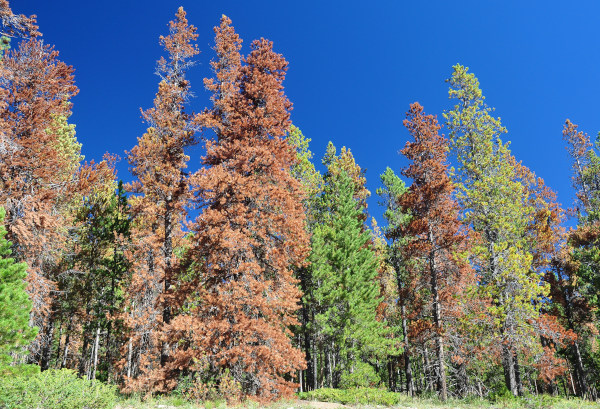
Fading or Discoloring Needles
Healthy green needles that turn yellowish, then rusty red. By the time an entire crown is red, the beetles have typically already exited the tree and moved to new hosts.
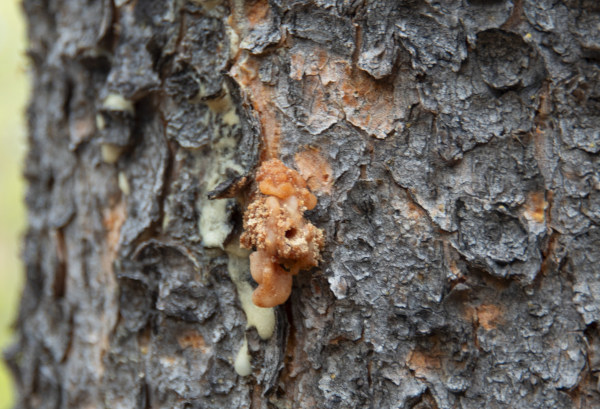
Pitch Tubes on the Trunk
Small, popcorn-shaped masses of resin on the bark surface. These form when the tree tries to "pitch out" boring beetles. Reddish-brown pitch tubes indicate a failed defense.
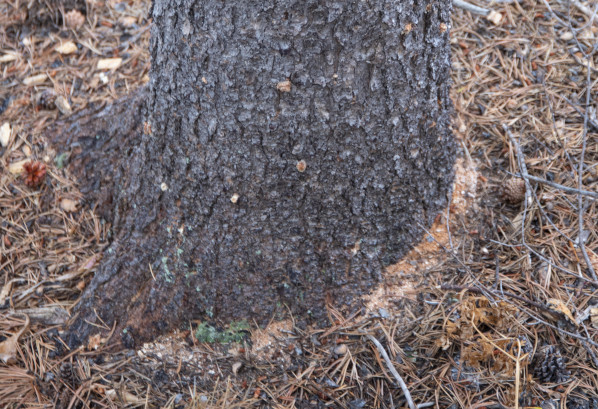
Boring Dust (Frass)
Fine, reddish-brown sawdust accumulating in bark crevices, around the base of the tree, and on spider webs nearby. This indicates active beetle tunneling beneath the bark.
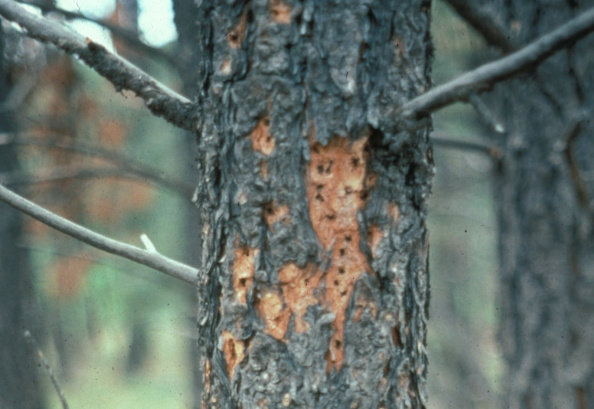
Woodpecker Activity
Heavy woodpecker feeding on trunk and branches strips bark as they search for beetle larvae. Large patches of light-colored, exposed wood are a telltale sign of severe infestation.
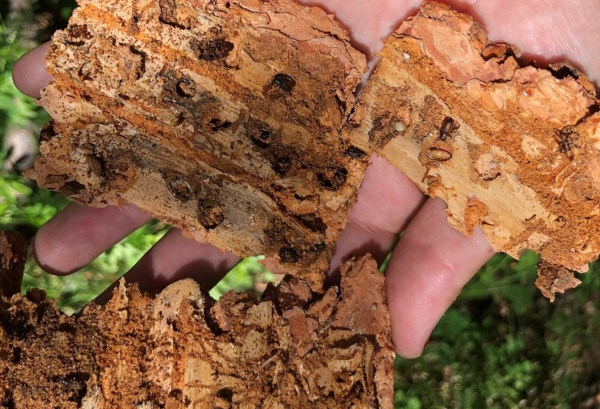
J-Shaped Galleries Under Bark
Peel back a small section of loose bark to reveal tunneling patterns. Mountain pine beetles create distinctive J- or Y-shaped egg galleries carved into the inner bark.
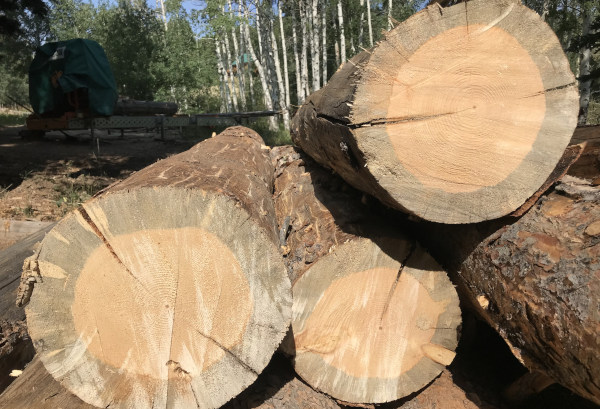
Blue Stain Fungus
Beetles carry blue stain fungus that blocks the tree's water-conducting tissues. Cross-cut sections of affected wood show distinctive blue-gray streaking through the sapwood.
Photos: Colorado State Forest Service
Nearby Front Range Communities
Castle Pines
Douglas County
Beetle Activity Documented
Castle Rock
Douglas County
Beetle Activity Documented
Highlands Ranch
Douglas County
Beetle Activity Documented
Lone Tree
Douglas County
Beetle Activity Documented
Parker
Douglas County
Beetle Activity Documented
Sedalia
Douglas County
Beetle Activity Documented
Latest from the Blog
View All →
Colorado's 2026 Pine Beetle Response: Task Force, Funding, and What It Means for Homeowners
Governor Polis created a statewide task force, Jefferson County launched a $500K cost-share program, and the legislature is funding biological controls. Here's what Colorado is actually doing about the pine beetle outbreak — and what homeowners need to know.

Colorado's Ponderosa Mountain Pine Beetle Task Force: What It Is, Who's Behind It, and What It Means for the Front Range
Colorado's Ponderosa Mountain Pine Beetle Task Force was created to fight the expanding Front Range outbreak. Here's what the task force is doing and what it means for you.