
Pine Beetle Prevention in Littleton, Colorado
Protect your trees from bark beetle infestations in Littleton, Arapahoe County. Local prevention tips, risk assessment, and professional resources.
Elevation
5,351'
Population
48,162
County
Arapahoe
Primary Trees
Ponderosa Pine
CSFS Mountain Pine Beetle Activity — Arapahoe County
Documented
Active beetles in county
Adjacent
Nearby counties affected
Not Documented
No confirmed activity
Source: Colorado State Forest Service aerial surveys, 2024
Mountain Pine Beetle in Arapahoe County
Arapahoe County does not have CSFS-documented mountain pine beetle activity, but its proximity to affected counties — Douglas to the south and Jefferson to the west — means beetles could spread into the area.
Arapahoe County Details
While lower-elevation urban and suburban communities in Arapahoe County face less risk than foothill towns, Ips engraver beetles are increasingly active in Denver metro area pines. Drought-stressed landscape pines in communities like Centennial and Littleton remain vulnerable.
Key Finding
No confirmed MPB activity, but adjacent to multiple documented counties
Front Range Outbreak Trend
Acres of MPB-caused tree mortality, Front Range. Source: CSFS Aerial Surveys, 2020–2024
700K+
Acres of vulnerable pine along the Front Range
1,767%
Increase in affected acres, 2020–2024
Data sourced from Colorado State Forest Service aerial survey reports, forest health publications, and local reporting.
Pine Beetle Guide for Littleton, Colorado
Littleton is a well-established city of over 48,000 residents in Arapahoe County, situated at 5,351 feet along the South Platte River corridor where the plains meet the foothills. One of the Denver metro area's oldest communities, Littleton blends historic downtown charm with mature residential neighborhoods featuring tree-lined streets and established landscapes. While Littleton is more urbanized than the mountain communities to the west and south, Ponderosa Pine remains a significant component of the city's urban forest — particularly in the western neighborhoods near the Ken Caryl area, along the Highline Canal corridor, and in older subdivisions where native pines were preserved during mid-century development. The city's foothills-adjacent position brings moderate but real pine beetle risk that requires awareness from property owners.
Pine Beetle Risk in Littleton
Littleton carries a Moderate pine beetle risk rating, the lowest designation that still warrants active management attention. This rating reflects the city's lower elevation and more urbanized landscape compared to the mountain and Palmer Divide communities, while acknowledging that significant beetle threats exist in specific areas.
At 5,351 feet, Littleton sits below the elevation band where mountain pine beetles are most active in Colorado. The city's beetle risk is driven primarily by Ips engraver beetles rather than mountain pine beetles, and the risk is concentrated in areas where Ponderosa Pine density is highest — the southwestern neighborhoods bordering Ken Caryl Ranch, the Columbine area, and along the bluffs above the South Platte River.
Littleton's urban heat island effect — generated by extensive pavement, buildings, and reduced vegetation cover compared to surrounding areas — creates microclimates several degrees warmer than nearby rural landscapes. This warmth accelerates Ips beetle development cycles and can extend their active season by two to four weeks compared to higher-elevation communities.
The city's soils are predominantly heavy clay derived from the Pierre Shale and Denver Formation — dense, poorly drained substrates that pose challenges for Ponderosa Pine health. Trees growing in compacted clay soils develop restricted root systems that are less efficient at water uptake, particularly during drought. When combined with urban stressors like soil compaction from foot traffic, chemical exposure from lawn treatments, and reflected heat from pavement, Littleton's Ponderosas can become significantly stressed even in years of near-normal precipitation.
The Highline Canal, which traverses Littleton, was historically lined with Ponderosa Pine and other conifers. Changes in canal operations and periods of reduced water flow have stressed these corridor trees, creating pockets of beetle-susceptible pines that thread through the city.
Prevention Tips for Littleton Properties
Littleton's Moderate risk level allows for a more targeted and less intensive prevention approach than mountain communities, with emphasis on urban tree health fundamentals.
Clay Soil Improvement as Primary Defense: The single most impactful thing Littleton homeowners can do for their Ponderosa Pines is break the clay-compaction cycle around the tree. Convert the area beneath the canopy from turf grass to a deep organic mulch bed — three to four inches of wood chips or bark mulch from six inches off the trunk to at least the drip line. This one change reduces compaction, moderates extreme soil temperatures, retains moisture, eliminates turf grass competition for water and nutrients, and prevents mower and string-trimmer damage to the trunk base. In Littleton's heavy clay soils, establishing a mulch bed can measurably improve tree health within two growing seasons, shifting a stressed pine from beetle-vulnerable to beetle-resistant.
Slow-Absorption Watering for Clay: Littleton's clay soils hold moisture well but absorb water slowly. Fast watering runs off the surface or ponds in depressions, alternately drowning and drying roots. Use a soaker hose at the drip line set to a bare trickle for four to six hours once monthly during dry periods — July through October and again February through April in dry winters. Avoid overwatering, which in clay soils creates anaerobic conditions that damage roots and can cause root rot. The key metric is not volume per application but rate of delivery — slow enough to soak in, deep enough to reach the 12-to-18-inch root zone.
Early Pruning Timing: Schedule all Ponderosa Pine pruning between November and mid-March. In Littleton's warmer urban climate, Ips beetles may activate as early as late March in warm years. Err on the side of completing pruning by mid-March rather than pushing into April. If emergency storm-damage pruning is needed during warm months, remove all cut material from the property within 24 hours and apply a pruning sealant to fresh wounds — this is one of the few situations where sealant is advisable, as it blocks the terpene release that attracts beetles.
Monitor and Remove Declining Trees Proactively: A slowly declining Ponderosa in Littleton's urban setting can harbor Ips beetles for several seasons, producing successive generations that attack nearby trees. If a tree shows progressive crown decline over two or more years despite improved watering and mulching, it may be past saving — and each additional season it stands, it breeds beetles. Consider removing chronically declining trees before they become a neighborhood beetle source. Littleton's Community Development Department can advise on any permit requirements.
Selective Preventive Treatment: Blanket preventive spraying is generally unnecessary in Littleton. Reserve bark spray treatments for specimen trees of exceptional value — the century-old Ponderosa that defines your yard, a privacy screen you cannot replace — that are either showing early stress symptoms or located within 200 feet of a recently killed pine. Apply carbaryl or bifenthrin between mid-April and late May.
Local Resources
- City of Littleton Parks and Open Space manages city-owned trees and can advise on tree health concerns in parks, along streets, and in public rights-of-way. Their arborists can assess whether a declining tree is beetle-related or suffering from other urban stress factors.
- Arapahoe County Extension Office (CSU Extension) provides free diagnostic services for tree health issues, including beetle identification from bark and wood samples. Bring a sample to their office for species identification and treatment recommendations.
- South Suburban Parks and Recreation manages open spaces in the Littleton area with Ponderosa Pine, including trail corridors where beetle conditions can be observed.
- Chatfield State Park (adjacent to western Littleton) monitors beetle activity within the park and can provide condition reports relevant to nearby residential areas.
- Colorado State Forest Service offers technical consultation for urban and community forestry issues, including distinguishing beetle damage from other causes of tree decline in urban environments.
- Littleton Tree Board advises the city on urban forestry matters and periodically addresses tree health topics at public meetings — check the city calendar for upcoming sessions.
Nearby Affected Areas
Littleton's beetle risk is influenced by conditions in the communities surrounding it. To the south, Highlands Ranch carries a High risk rating, and beetles from its more heavily forested landscape can drift northward into Littleton. Morrison to the west sits at the mouth of Bear Creek Canyon with High beetle risk in its dense foothill forest. Lakewood to the north shares Littleton's Moderate risk profile and similar urban pine challenges. Centennial to the east faces comparable conditions. And Golden to the northwest, where the foothills meet the plains, manages a moderate beetle threat in its foothill-adjacent neighborhoods. Monitoring beetle activity in these surrounding communities helps Littleton residents anticipate changing pressure levels.
Common Pine Beetle Species in Colorado
Three bark beetle species pose the greatest threat to pine trees in Littleton and across Colorado's Front Range.
Mountain Pine Beetle
Dendroctonus ponderosae
The primary killer of Ponderosa and Lodgepole pines along the Front Range. Adults are black, about the size of a grain of rice (5mm). They use aggregation pheromones to coordinate mass attacks that overwhelm a tree's pitch defenses.
- ● Targets trees 8"+ diameter
- ● One generation per year (July–August flight)
- ● Carries blue stain fungus that blocks water transport
- ● Creates J-shaped egg galleries under bark
Ips Engraver Beetle
Ips pini
A smaller, opportunistic beetle that exploits any weakness: drought stress, pruning wounds, fresh slash piles, or construction damage to roots. Less dramatic than MPB but persistent and hard to prevent entirely.
- ● Attacks trees of any size, including limbs
- ● 2–3 generations per year (April–October)
- ● Creates Y-shaped egg galleries under bark
- ● Often the first beetle to attack stressed trees
Red Turpentine Beetle
Dendroctonus valens
The largest bark beetle in North America (up to 10mm). Typically attacks the lower trunk of weakened or injured trees. Rarely kills trees on its own but signals stress that can attract MPB and Ips beetles.
- ● Attacks lower 6 feet of trunk
- ● Produces large, quarter-sized pitch tubes
- ● Indicator species for tree stress
- ● Often found after construction or root damage
Species data: Colorado State Forest Service, USDA Forest Service
Signs of Pine Beetle Infestation
Knowing what to look for is the first step to protecting your Littleton property. Here are the key warning signs every homeowner should monitor.
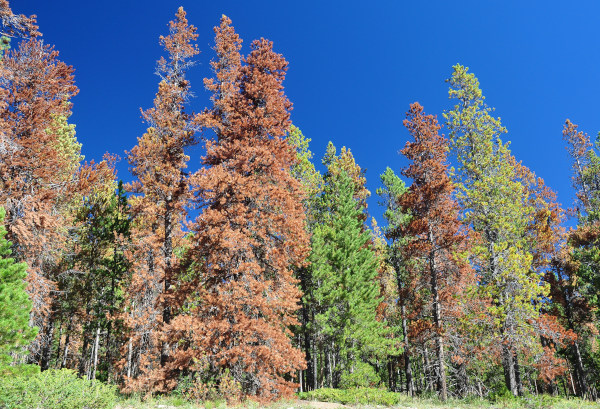
Fading or Discoloring Needles
Healthy green needles that turn yellowish, then rusty red. By the time an entire crown is red, the beetles have typically already exited the tree and moved to new hosts.
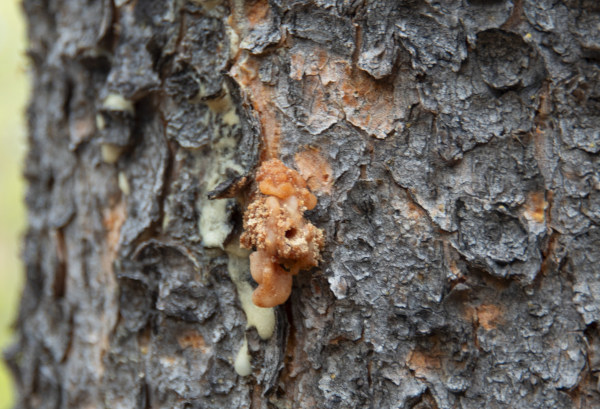
Pitch Tubes on the Trunk
Small, popcorn-shaped masses of resin on the bark surface. These form when the tree tries to "pitch out" boring beetles. Reddish-brown pitch tubes indicate a failed defense.
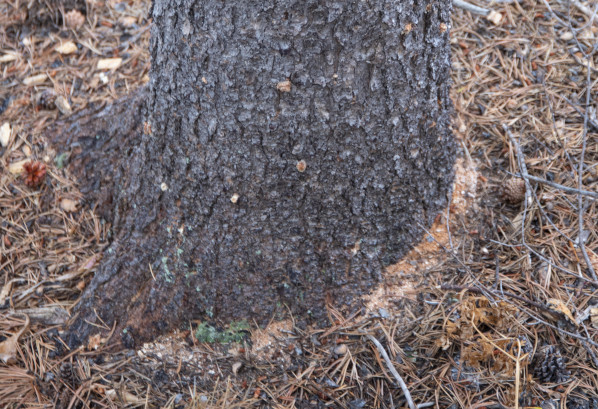
Boring Dust (Frass)
Fine, reddish-brown sawdust accumulating in bark crevices, around the base of the tree, and on spider webs nearby. This indicates active beetle tunneling beneath the bark.
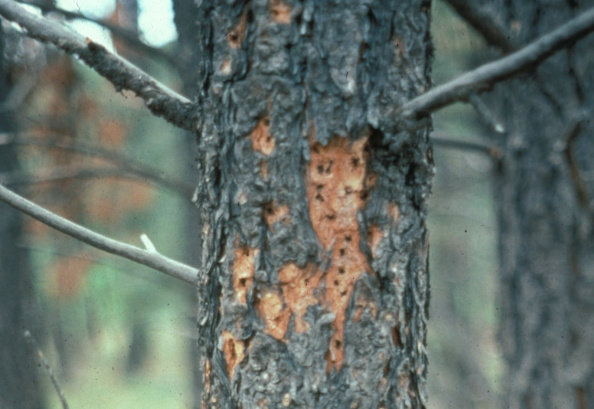
Woodpecker Activity
Heavy woodpecker feeding on trunk and branches strips bark as they search for beetle larvae. Large patches of light-colored, exposed wood are a telltale sign of severe infestation.
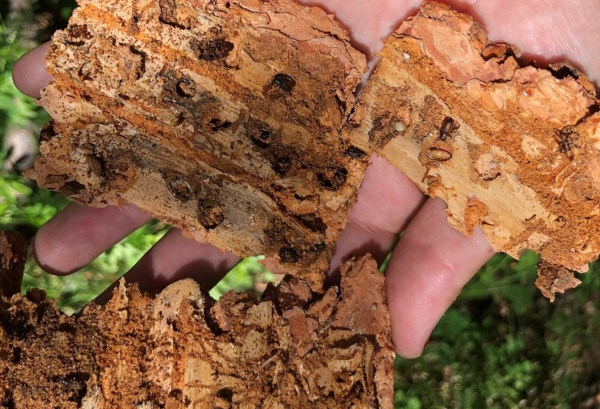
J-Shaped Galleries Under Bark
Peel back a small section of loose bark to reveal tunneling patterns. Mountain pine beetles create distinctive J- or Y-shaped egg galleries carved into the inner bark.
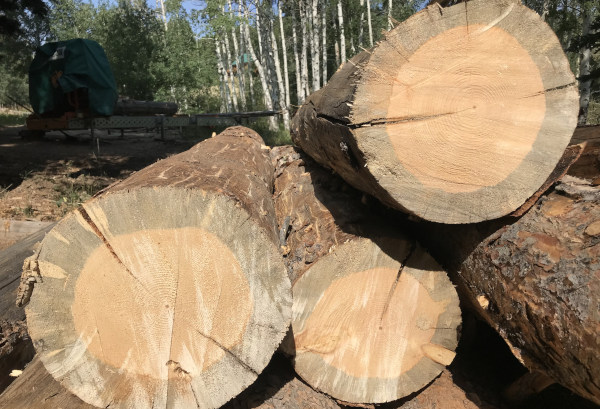
Blue Stain Fungus
Beetles carry blue stain fungus that blocks the tree's water-conducting tissues. Cross-cut sections of affected wood show distinctive blue-gray streaking through the sapwood.
Photos: Colorado State Forest Service
Nearby Front Range Communities
Latest from the Blog
View All →
Colorado's 2026 Pine Beetle Response: Task Force, Funding, and What It Means for Homeowners
Governor Polis created a statewide task force, Jefferson County launched a $500K cost-share program, and the legislature is funding biological controls. Here's what Colorado is actually doing about the pine beetle outbreak — and what homeowners need to know.

Colorado's Ponderosa Mountain Pine Beetle Task Force: What It Is, Who's Behind It, and What It Means for the Front Range
Colorado's Ponderosa Mountain Pine Beetle Task Force was created to fight the expanding Front Range outbreak. Here's what the task force is doing and what it means for you.