
Pine Beetle Prevention in Golden, Colorado
Protect your trees from bark beetle infestations in Golden, Jefferson County. Local prevention tips, risk assessment, and professional resources.
Elevation
5,675'
Population
21,286
County
Jefferson
Primary Trees
Ponderosa Pine
CSFS Mountain Pine Beetle Activity — Jefferson County
Documented
Active beetles in county
Adjacent
Nearby activity
Not Documented
No confirmed activity
Source: Colorado State Forest Service aerial surveys, 2024
Mountain Pine Beetle in Jefferson County
Jefferson County has documented approximately 20 acres of visible ponderosa pine mortality near I-70 and Soda Creek Road, with active treatment programs underway at Elk Meadow and Meyer Ranch parks.
Jefferson County Details
Jeffco Parks and Open Space treated 21+ acres at Elk Meadow Park in 2025, removing 45+ loads of infected logs. An additional 185 acres of mixed-conifer treatment is planned at Meyer Ranch Park for summer 2026. A new landowner cost-assistance program for MPB mitigation launches in 2026. Commissioner Lesley Dahlkemper serves on the state Pine Beetle Task Force.
Key Finding
21+ acres treated at Elk Meadow Park; 185-acre treatment planned at Meyer Ranch for 2026
Front Range Outbreak Trend
Acres of MPB-caused tree mortality, Front Range. Source: CSFS Aerial Surveys, 2020–2024
700K+
Acres of vulnerable pine along the Front Range
1,767%
Increase in affected acres, 2020–2024
Data sourced from Colorado State Forest Service aerial survey reports, forest health publications, and local reporting.
Pine Beetle Guide for Golden, Colorado
Golden is a city of approximately 21,286 residents in Jefferson County, nestled at 5,675 feet at the base of the foothills where Clear Creek emerges from the mountains. Best known as the home of the Colorado School of Mines and the Coors Brewing Company, Golden straddles the transition between the urban Front Range and the forested mountain corridor. The city is framed by North and South Table Mountains — flat-topped mesas capped with volcanic basalt — and flanked by forested foothills that climb westward toward Lookout Mountain and the mountain communities beyond. Ponderosa Pine covers the foothills slopes above downtown, the flanks of the Table Mountains, and extends into residential neighborhoods like Lookout Mountain, Genesee, and the areas along Highway 6 toward the tunnels. While less densely forested than mountain communities to the west, Golden's pine population is substantial and faces Moderate but meaningful beetle risk.
Pine Beetle Risk in Golden
Golden is rated Moderate for pine beetle risk, reflecting its transitional position between the heavily forested mountain communities to the west and the urbanized Denver metro to the east.
At 5,675 feet, Golden sits below the elevation where mountain pine beetles maintain consistent populations, but the city's foothill geography creates microclimates and forest conditions that push local risk above what the elevation alone would suggest. The steep, south-facing slopes of Lookout Mountain and the canyon walls along Clear Creek create hot, dry microhabitats where Ponderosa Pines experience significant drought stress — conditions that attract beetles despite the moderate elevation.
Golden's beetle risk is geographically concentrated. The western half of the city — Lookout Mountain, the Genesee area, and neighborhoods along Highway 6 and Highway 93 — features dense Ponderosa Pine on steep terrain and faces risk approaching the High threshold. The eastern half — the Table Mountain area, downtown, and the plains neighborhoods — has scattered pines in an urban setting and faces lower risk. This east-west gradient means beetle management in Golden is a localized rather than city-wide concern.
The Clear Creek corridor serves as a natural conduit for beetle dispersal from the mountain communities of Idaho Springs, Georgetown, and the upper watershed. These communities experienced severe mountain pine beetle epidemics during the 2006-2013 outbreak cycle, and beetles dispersing down the drainage arrived in Golden's upper-elevation neighborhoods. The same dynamic applies to the Bear Creek corridor, connecting Golden to Evergreen and Morrison through adjacent drainage networks.
Golden's soils reflect its geological diversity. The Table Mountains feature clay-rich soils from Denver Formation shale, while the foothills slopes are decomposed granite and metamorphic rock — thin, rocky, and fast-draining. Ponderosa Pines on the foothills soils face regular drought stress, while those on the Table Mountain soils contend with poor drainage and compaction.
The Colorado School of Mines campus and Golden's historic downtown include mature Ponderosa Pine specimens that are valued community landmarks. These urban trees face stress from soil compaction, reflected heat, and limited root zones, making them potential beetle targets.
Prevention Tips for Golden Properties
Golden's two-zone risk profile demands tailored prevention — foothills properties need thinning and spraying while urban properties need soil and stress management.
Lookout Mountain and Genesee — Thin Like a Mountain Community: Properties at these higher elevations should be managed like mountain properties. Thin Ponderosa Pine to 50 to 70 trees per acre, removing the smallest, weakest, and most crowded individuals. Create 100-foot defensible space zones around structures. The Lookout Mountain Fire Protection District provides free defensible space assessments that incorporate beetle management recommendations. On Lookout Mountain's steep slopes, hand-crew thinning is often the only practical approach — budget accordingly.
Urban Properties — Break the Compaction Cycle: For Ponderosa Pines in Golden's downtown, campus area, and lower neighborhoods, the most effective prevention is removing the chronic stressors that weaken trees. Protect root zones from vehicle and foot traffic. Maintain mulch beds — three to four inches of organic material from trunk to drip line — rather than turf grass under the canopy. If trees grow near sidewalks or driveways that are being replaced, insist on root-sensitive construction methods that avoid severing major roots.
Geology-Matched Watering: On the foothills decomposed granite soils, water Ponderosas monthly during dry periods using a soaker hose at the drip line for four to six hours — the fast-draining soil requires volume to get moisture deep enough to reach roots. On the Table Mountain clay soils, water less frequently — every six to eight weeks — at slower delivery rates to allow clay absorption. In both soil types, winter watering from October through March during dry periods is important for maintaining tree moisture reserves through the dormant season.
Pruning Standards Across Jurisdictions: Golden's unique governance splits beetle management responsibility between the city (incorporated areas) and Jefferson County (Lookout Mountain, Genesee, and other unincorporated neighborhoods). Regardless of jurisdiction, all Ponderosa Pine pruning should occur between November and March. Coordinate with HOAs, landscape contractors, and neighbors to enforce this standard uniformly. In the foothills neighborhoods where mountain beetle populations are present during warm months, the consequence of improper summer pruning is more severe than in the urban core.
Community Engagement Through Institutions: Golden's institutional anchors — Colorado School of Mines, Coors, the City of Golden, Jefferson County Open Space — create opportunities for community-level beetle awareness. The Colorado State Forest Service Golden District office is headquartered in Golden, making expert consultation locally accessible. Engage with city forestry programs, attend open space management meetings, and leverage the School of Mines' research community for technical information. Few Front Range communities have this concentration of forestry expertise available locally.
Local Resources
- Colorado State Forest Service — Golden District is headquartered in Golden and serves all of Jefferson County. Their office provides technical assistance, beetle identification, forest management planning, and administers cost-sharing programs. Being local makes them the most accessible state forestry resource for any Golden resident.
- Jefferson County Open Space manages North Table Mountain, South Table Mountain, Lookout Mountain, and other open spaces near Golden with active forest health monitoring programs.
- City of Golden Forestry Program manages city-owned street and park trees and can advise on tree health issues within city limits.
- Lookout Mountain Fire Protection District provides defensible space assessments and wildfire mitigation guidance for the foothills properties above Golden.
- Colorado School of Mines manages significant Ponderosa Pine assets on campus and has partnered with forestry organizations on tree health research. Their expertise is a community asset.
- Clear Creek Watershed Foundation coordinates watershed health initiatives including forest management in the Clear Creek corridor through Golden.
Nearby Affected Areas
Golden sits at the transition between mountain beetle country and the urban Front Range. Evergreen to the southwest carries Critical risk at 7,220 feet, and beetles from Evergreen's dense mixed conifer forest disperse toward Golden through the Bear Creek corridor. Morrison to the south faces High risk in a similar canyon setting. Conifer to the southwest, at over 8,200 feet, experiences some of the most intense beetle pressure in Jefferson County. Lakewood to the east shares Golden's Moderate risk profile in a more suburban setting. Boulder to the north faces High risk in its mountain park system and foothill neighborhoods. Golden's position as the foothills gateway means its beetle conditions are influenced by both mountain and urban dynamics.
Common Pine Beetle Species in Colorado
Three bark beetle species pose the greatest threat to pine trees in Golden and across Colorado's Front Range.
Mountain Pine Beetle
Dendroctonus ponderosae
The primary killer of Ponderosa and Lodgepole pines along the Front Range. Adults are black, about the size of a grain of rice (5mm). They use aggregation pheromones to coordinate mass attacks that overwhelm a tree's pitch defenses.
- ● Targets trees 8"+ diameter
- ● One generation per year (July–August flight)
- ● Carries blue stain fungus that blocks water transport
- ● Creates J-shaped egg galleries under bark
Ips Engraver Beetle
Ips pini
A smaller, opportunistic beetle that exploits any weakness: drought stress, pruning wounds, fresh slash piles, or construction damage to roots. Less dramatic than MPB but persistent and hard to prevent entirely.
- ● Attacks trees of any size, including limbs
- ● 2–3 generations per year (April–October)
- ● Creates Y-shaped egg galleries under bark
- ● Often the first beetle to attack stressed trees
Red Turpentine Beetle
Dendroctonus valens
The largest bark beetle in North America (up to 10mm). Typically attacks the lower trunk of weakened or injured trees. Rarely kills trees on its own but signals stress that can attract MPB and Ips beetles.
- ● Attacks lower 6 feet of trunk
- ● Produces large, quarter-sized pitch tubes
- ● Indicator species for tree stress
- ● Often found after construction or root damage
Species data: Colorado State Forest Service, USDA Forest Service
Signs of Pine Beetle Infestation
Knowing what to look for is the first step to protecting your Golden property. Here are the key warning signs every homeowner should monitor.
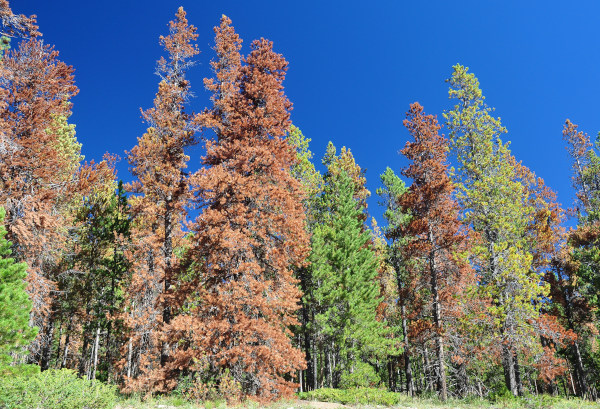
Fading or Discoloring Needles
Healthy green needles that turn yellowish, then rusty red. By the time an entire crown is red, the beetles have typically already exited the tree and moved to new hosts.
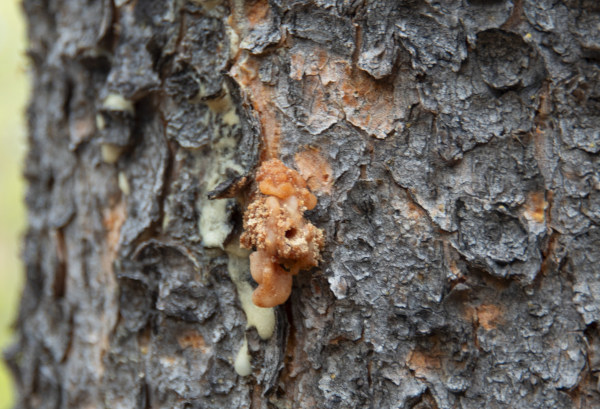
Pitch Tubes on the Trunk
Small, popcorn-shaped masses of resin on the bark surface. These form when the tree tries to "pitch out" boring beetles. Reddish-brown pitch tubes indicate a failed defense.
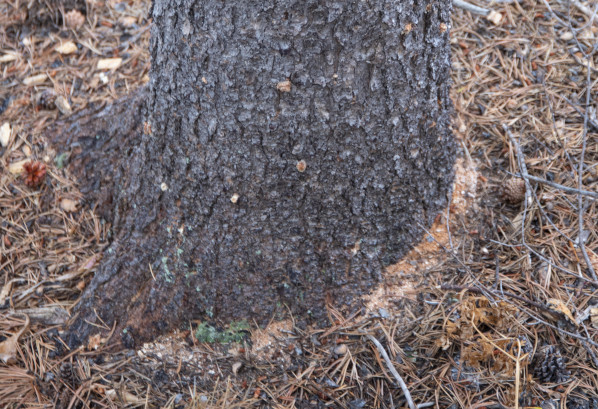
Boring Dust (Frass)
Fine, reddish-brown sawdust accumulating in bark crevices, around the base of the tree, and on spider webs nearby. This indicates active beetle tunneling beneath the bark.
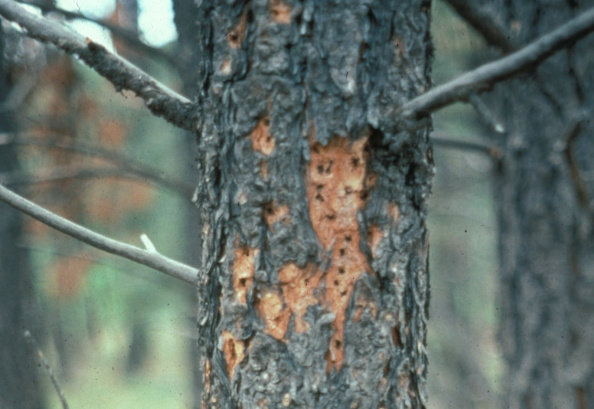
Woodpecker Activity
Heavy woodpecker feeding on trunk and branches strips bark as they search for beetle larvae. Large patches of light-colored, exposed wood are a telltale sign of severe infestation.
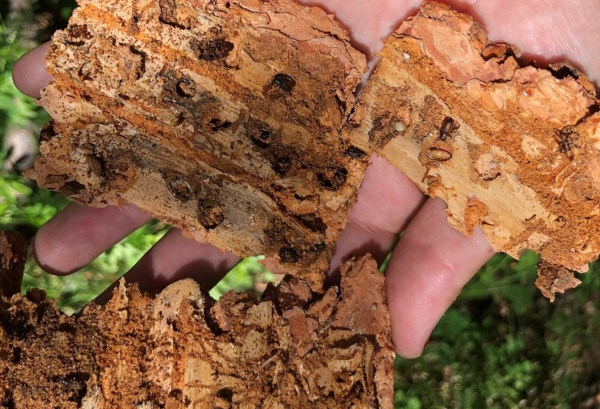
J-Shaped Galleries Under Bark
Peel back a small section of loose bark to reveal tunneling patterns. Mountain pine beetles create distinctive J- or Y-shaped egg galleries carved into the inner bark.
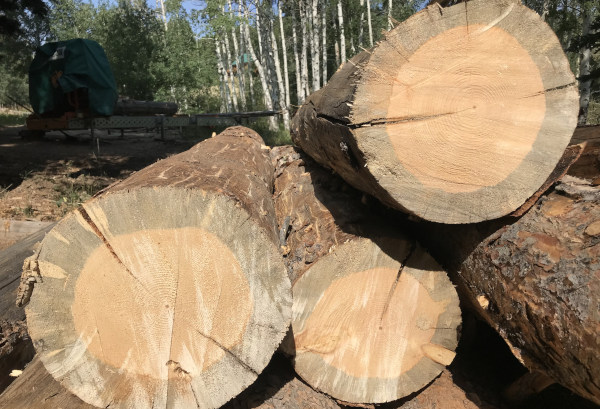
Blue Stain Fungus
Beetles carry blue stain fungus that blocks the tree's water-conducting tissues. Cross-cut sections of affected wood show distinctive blue-gray streaking through the sapwood.
Photos: Colorado State Forest Service
Nearby Front Range Communities
Latest from the Blog
View All →
Colorado's 2026 Pine Beetle Response: Task Force, Funding, and What It Means for Homeowners
Governor Polis created a statewide task force, Jefferson County launched a $500K cost-share program, and the legislature is funding biological controls. Here's what Colorado is actually doing about the pine beetle outbreak — and what homeowners need to know.

Colorado's Ponderosa Mountain Pine Beetle Task Force: What It Is, Who's Behind It, and What It Means for the Front Range
Colorado's Ponderosa Mountain Pine Beetle Task Force was created to fight the expanding Front Range outbreak. Here's what the task force is doing and what it means for you.