
Pine Beetle Prevention in Lakewood, Colorado
Protect your trees from bark beetle infestations in Lakewood, Jefferson County. Local prevention tips, risk assessment, and professional resources.
Elevation
5,518'
Population
157,906
County
Jefferson
Primary Trees
Ponderosa Pine
CSFS Mountain Pine Beetle Activity — Jefferson County
Documented
Active beetles in county
Adjacent
Nearby activity
Not Documented
No confirmed activity
Source: Colorado State Forest Service aerial surveys, 2024
Mountain Pine Beetle in Jefferson County
Jefferson County has documented approximately 20 acres of visible ponderosa pine mortality near I-70 and Soda Creek Road, with active treatment programs underway at Elk Meadow and Meyer Ranch parks.
Jefferson County Details
Jeffco Parks and Open Space treated 21+ acres at Elk Meadow Park in 2025, removing 45+ loads of infected logs. An additional 185 acres of mixed-conifer treatment is planned at Meyer Ranch Park for summer 2026. A new landowner cost-assistance program for MPB mitigation launches in 2026. Commissioner Lesley Dahlkemper serves on the state Pine Beetle Task Force.
Key Finding
21+ acres treated at Elk Meadow Park; 185-acre treatment planned at Meyer Ranch for 2026
Front Range Outbreak Trend
Acres of MPB-caused tree mortality, Front Range. Source: CSFS Aerial Surveys, 2020–2024
700K+
Acres of vulnerable pine along the Front Range
1,767%
Increase in affected acres, 2020–2024
Data sourced from Colorado State Forest Service aerial survey reports, forest health publications, and local reporting.
Pine Beetle Guide for Lakewood, Colorado
Lakewood is the fifth-largest city in Colorado, home to nearly 158,000 residents spread across the western Denver metro area at an elevation of 5,518 feet. Stretching from the Sixth Avenue freeway corridor on the north to Chatfield Reservoir on the south, and from the urban edge of Denver on the east to the foothills hogback on the west, Lakewood is a sprawling suburban city with a surprisingly diverse landscape. The western neighborhoods — Green Mountain, Bear Creek Lake Park vicinity, and the areas along the hogback near Dinosaur Ridge — feature significant Ponderosa Pine on foothills terrain, while central and eastern Lakewood is thoroughly suburban with scattered landscape pines. Lakewood's position between the urbanized flats and the forested foothills places it in a transitional zone for beetle activity, warranting the community's Moderate risk classification.
Pine Beetle Risk in Lakewood
Lakewood is rated Moderate for pine beetle risk, reflecting its predominantly suburban character and lower elevation, tempered by meaningful beetle exposure in its western foothills neighborhoods.
At 5,518 feet, Lakewood sits below the consistent mountain pine beetle activity zone but features enough Ponderosa Pine — particularly in its western half — to support Ips beetle populations. The city's beetle risk is geographically concentrated along the western boundary where the Front Range hogback marks the abrupt transition from plains to mountains.
Green Mountain, a prominent 6,800-foot mesa in western Lakewood managed by Lakewood and Jefferson County as open space, supports substantial Ponderosa Pine on its slopes and ridges. The mountain's pine population has experienced periodic beetle activity, and the open space management plan includes forest health provisions addressing beetle risk. Bear Creek Lake Park, also in western Lakewood, contains Ponderosa Pine stands along its trail system that are monitored for beetle activity.
The hogback corridor along Lakewood's western boundary — from Dinosaur Ridge south to Chatfield — is a strip of Ponderosa Pine habitat that connects to the foothills forests of Morrison, Evergreen, and Conifer. This corridor serves as a pathway for beetles moving from the heavily infested mountain communities eastward into Lakewood's suburban neighborhoods. Properties along Rooney Road, near Bear Creek Lake Park, and in the Green Mountain area face higher beetle pressure than central or eastern Lakewood.
Lakewood's soils reflect its geological setting. The western foothills feature thin, rocky soils over sandstone and shale, while the central and eastern areas sit on deep clay from the Denver Formation. Ponderosa Pines in both soil types face stress — drought on the rocky western soils, compaction and poor drainage on the eastern clay. The extensive impervious surface in Lakewood's developed areas generates a measurable urban heat island effect that extends the beetle activity season.
Lakewood's development timeline matters for beetle risk. Much of the city was built between the 1950s and 1980s, and Ponderosa Pines planted during that era are now 40 to 70 years old — mature enough to be attractive beetle hosts and potentially showing age-related decline that increases vulnerability. Many of these trees were planted in heavy clay fill soil moved during construction, further compromising their long-term health.
Prevention Tips for Lakewood Properties
Lakewood's prevention approach addresses two distinct challenges: managing aging suburban landscape trees in the city's central and eastern areas, and managing foothills interface risk along the western boundary.
Green Mountain and Hogback Properties — Foothills Standards: Properties near Green Mountain and the hogback should be managed using foothills-community standards. Thin Ponderosa Pine to 50 to 70 trees per acre around structures. The West Metro Fire Protection District provides wildfire mitigation assessments that include beetle management for properties along Lakewood's western boundary. Create defensible space that simultaneously reduces beetle habitat and fire fuel — the dual benefit makes this one of the best property investments in western Lakewood.
Rejuvenate Aging Landscape Trees: For the development-era Ponderosas that form the backbone of Lakewood's urban pine population, the most effective prevention is reversing decades of accumulated urban stress. Start with the root zone: convert turf to mulch under the canopy, three to four inches deep from six inches off the trunk to the drip line. Follow with annual topdressing of compost over the mulch bed to rebuild the soil biology that decades of turf management depleted. The goal is to shift the tree's root environment from compacted, nutrient-depleted clay back toward the organic-enriched, well-aerated soil that Ponderosas evolved in. These soil improvements take two to three years to show results in crown health but are the only way to address the underlying cause of stress-related beetle vulnerability in Lakewood's aging landscape.
Dual-Soil Watering Strategies: Lakewood spans rocky western soils and clay eastern soils, and each requires a different watering approach. On the rocky soils near the hogback, water Ponderosas monthly during dry periods with a soaker hose at the drip line for four to six hours — volume is needed to push moisture through the fast-draining substrate. On the clay soils dominating central and eastern Lakewood, water every six weeks at a much slower trickle for six to eight hours — clay must absorb water gradually or it runs off. Winter watering once every six weeks during dry winters is important throughout Lakewood for maintaining dormant-season moisture reserves.
Dormant Season Pruning with HOA Enforcement: All Ponderosa Pine pruning should occur between November and March. Lakewood's numerous HOAs can be powerful enforcement mechanisms for this standard. Advocate for winter-only pine pruning requirements in community landscape contracts. Many Lakewood HOAs still use contractors who default to summer scheduling for operational convenience — changing this default to winter-only scheduling is one of the most impactful beetle prevention policies a community can adopt.
Proactive Dead and Declining Tree Removal: Lakewood's municipal code addresses hazard trees, and many HOAs require prompt dead tree removal. Go beyond these minimums — remove chronically declining Ponderosas (progressive thinning over two or more years, less than 50 percent crown density remaining) before they become full beetle production trees. A living but declining tree produces beetles for multiple seasons; removing it breaks the cycle for neighboring trees. Contact the City of Lakewood Community Resources Department for guidance on permit requirements.
Local Resources
- City of Lakewood Urban Forestry Program manages city-owned trees and provides guidance on residential and commercial tree health issues. Their arborists can assess whether a declining Ponderosa is beetle-related or suffering from other urban stress factors.
- Jefferson County Open Space manages Green Mountain and other open space in the Lakewood area with active forest health monitoring. Their beetle monitoring data for Green Mountain provides early warning for adjacent residential properties.
- West Metro Fire Protection District provides wildfire mitigation assessments for western Lakewood properties in the hogback wildland-urban interface.
- Colorado State Forest Service — Golden District provides technical assistance, cost-sharing programs, and beetle identification services for Jefferson County property owners.
- Bear Creek Lake Park monitors tree health within the park and can provide beetle condition information relevant to surrounding western Lakewood neighborhoods.
- CSU Extension — Jefferson County provides free tree health diagnostics and pest identification. Bring bark samples or photos for analysis.
- Lakewood Advisory Commission on the Environment periodically addresses urban forest and tree health topics at public meetings — attend when these topics are on the agenda.
Nearby Affected Areas
Lakewood is bordered by communities across the beetle risk spectrum. Morrison to the southwest faces High risk in its foothill canyon setting, and beetles from Morrison's forested slopes can disperse along the hogback into Lakewood. Golden to the northwest shares a foothill interface and Moderate risk. Evergreen and Conifer to the west carry Critical risk in their mountain forests — beetles from these communities follow drainages through the foothills toward Lakewood. Denver to the east shares Lakewood's Moderate urban beetle challenge. Littleton to the south faces similar conditions along the South Platte corridor. Lakewood's position along the foothill edge means its western neighborhoods serve as the first suburban buffer against beetle dispersal from the mountain communities.
Common Pine Beetle Species in Colorado
Three bark beetle species pose the greatest threat to pine trees in Lakewood and across Colorado's Front Range.
Mountain Pine Beetle
Dendroctonus ponderosae
The primary killer of Ponderosa and Lodgepole pines along the Front Range. Adults are black, about the size of a grain of rice (5mm). They use aggregation pheromones to coordinate mass attacks that overwhelm a tree's pitch defenses.
- ● Targets trees 8"+ diameter
- ● One generation per year (July–August flight)
- ● Carries blue stain fungus that blocks water transport
- ● Creates J-shaped egg galleries under bark
Ips Engraver Beetle
Ips pini
A smaller, opportunistic beetle that exploits any weakness: drought stress, pruning wounds, fresh slash piles, or construction damage to roots. Less dramatic than MPB but persistent and hard to prevent entirely.
- ● Attacks trees of any size, including limbs
- ● 2–3 generations per year (April–October)
- ● Creates Y-shaped egg galleries under bark
- ● Often the first beetle to attack stressed trees
Red Turpentine Beetle
Dendroctonus valens
The largest bark beetle in North America (up to 10mm). Typically attacks the lower trunk of weakened or injured trees. Rarely kills trees on its own but signals stress that can attract MPB and Ips beetles.
- ● Attacks lower 6 feet of trunk
- ● Produces large, quarter-sized pitch tubes
- ● Indicator species for tree stress
- ● Often found after construction or root damage
Species data: Colorado State Forest Service, USDA Forest Service
Signs of Pine Beetle Infestation
Knowing what to look for is the first step to protecting your Lakewood property. Here are the key warning signs every homeowner should monitor.
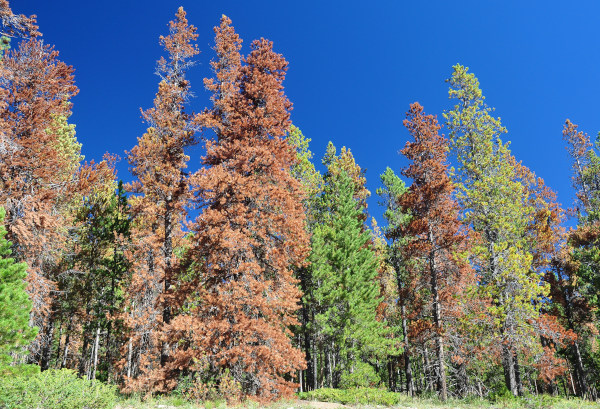
Fading or Discoloring Needles
Healthy green needles that turn yellowish, then rusty red. By the time an entire crown is red, the beetles have typically already exited the tree and moved to new hosts.
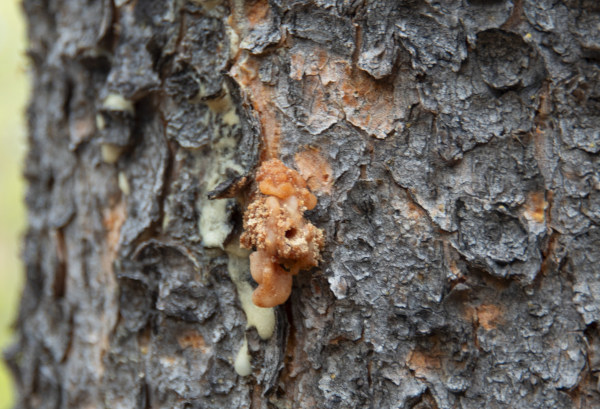
Pitch Tubes on the Trunk
Small, popcorn-shaped masses of resin on the bark surface. These form when the tree tries to "pitch out" boring beetles. Reddish-brown pitch tubes indicate a failed defense.
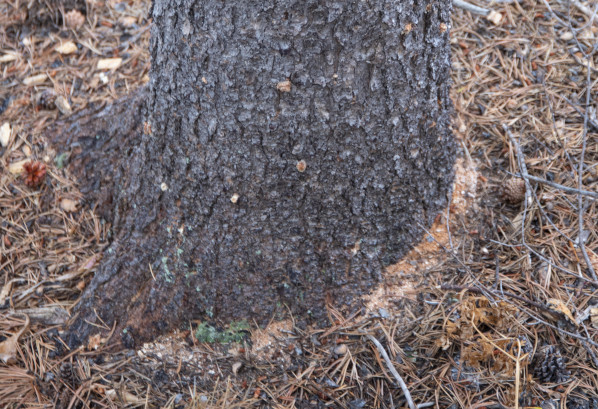
Boring Dust (Frass)
Fine, reddish-brown sawdust accumulating in bark crevices, around the base of the tree, and on spider webs nearby. This indicates active beetle tunneling beneath the bark.
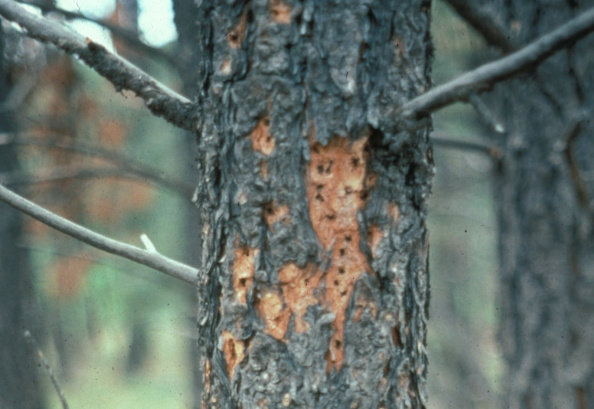
Woodpecker Activity
Heavy woodpecker feeding on trunk and branches strips bark as they search for beetle larvae. Large patches of light-colored, exposed wood are a telltale sign of severe infestation.
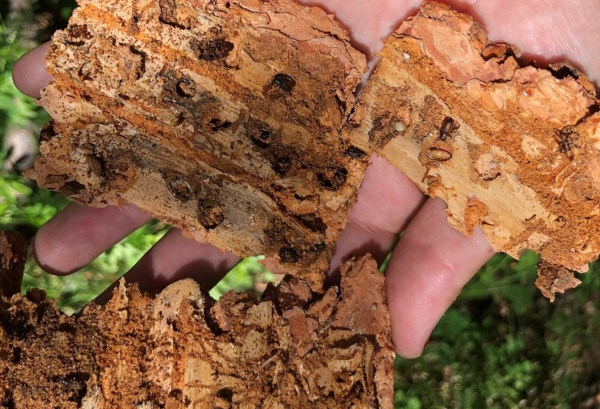
J-Shaped Galleries Under Bark
Peel back a small section of loose bark to reveal tunneling patterns. Mountain pine beetles create distinctive J- or Y-shaped egg galleries carved into the inner bark.
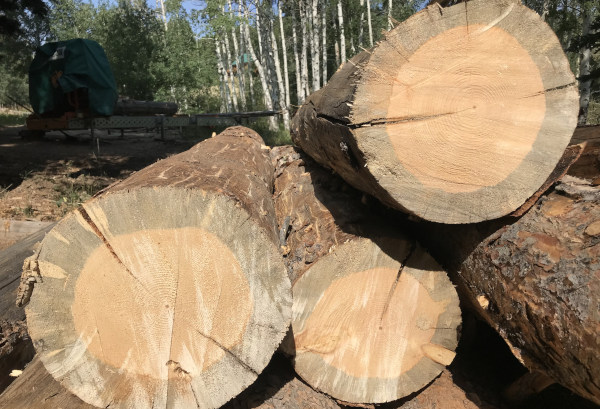
Blue Stain Fungus
Beetles carry blue stain fungus that blocks the tree's water-conducting tissues. Cross-cut sections of affected wood show distinctive blue-gray streaking through the sapwood.
Photos: Colorado State Forest Service
Nearby Front Range Communities
Latest from the Blog
View All →
Colorado's 2026 Pine Beetle Response: Task Force, Funding, and What It Means for Homeowners
Governor Polis created a statewide task force, Jefferson County launched a $500K cost-share program, and the legislature is funding biological controls. Here's what Colorado is actually doing about the pine beetle outbreak — and what homeowners need to know.

Colorado's Ponderosa Mountain Pine Beetle Task Force: What It Is, Who's Behind It, and What It Means for the Front Range
Colorado's Ponderosa Mountain Pine Beetle Task Force was created to fight the expanding Front Range outbreak. Here's what the task force is doing and what it means for you.