
Pine Beetle Prevention in Denver, Colorado
Protect your trees from bark beetle infestations in Denver, Denver County. Local prevention tips, risk assessment, and professional resources.
Elevation
5,280'
Population
711,463
County
Denver
Primary Trees
Ponderosa Pine
CSFS Mountain Pine Beetle Activity — Denver County
Documented
Active beetles in county
Adjacent
Nearby counties affected
Not Documented
No confirmed activity
Source: Colorado State Forest Service aerial surveys, 2024
Mountain Pine Beetle in Denver County
Denver County does not have CSFS-documented mountain pine beetle activity in its urban forests, but Ips engraver beetles are becoming an increasing concern in the metro area's landscape pines.
Denver County Details
Denver's urban heat island effect (5-10 degrees warmer than surrounding areas) and construction-related root damage make city pines vulnerable to stress-related beetle attacks. Local arborists report growing Ips beetle activity in neighborhoods with mature ponderosa plantings. The city's parks department manages groves in Washington Park, City Park, and other green spaces.
Key Finding
Ips engraver beetle activity increasing in urban pines; no confirmed MPB
Front Range Outbreak Trend
Acres of MPB-caused tree mortality, Front Range. Source: CSFS Aerial Surveys, 2020–2024
700K+
Acres of vulnerable pine along the Front Range
1,767%
Increase in affected acres, 2020–2024
Data sourced from Colorado State Forest Service aerial survey reports, forest health publications, and local reporting.
Pine Beetle Guide for Denver, Colorado
Denver is Colorado's capital and largest city, home to over 711,000 residents across 155 square miles at the iconic elevation of 5,280 feet — the Mile High City. Denver's urban forest is one of the most diverse in the American West, blending native species with extensive plantings of adapted and introduced trees. Ponderosa Pine, while not as dominant as in the foothills and mountain communities to the west, is a meaningful component of Denver's urban tree canopy. Mature Ponderosas line streets in older neighborhoods, anchor parks from Washington Park to City Park to Ruby Hill, provide shade on the grounds of the Denver Botanic Gardens, and serve as specimen trees in residential landscapes across the city. Denver's scale, urban character, and relatively low elevation produce a Moderate beetle risk rating, but the city's vast number of Ponderosa Pines means even moderate beetle pressure can affect thousands of trees.
Pine Beetle Risk in Denver
Denver is rated Moderate for pine beetle risk, the lowest level that warrants active management attention. This rating reflects the city's lower elevation, thoroughly urban character, and dispersed pine population.
At 5,280 feet, Denver sits below the elevation where mountain pine beetles maintain consistent populations. The city's beetle risk is overwhelmingly an Ips engraver beetle problem — these opportunistic insects exploit stressed urban trees rather than attacking healthy forests. Denver's Ponderosa Pines face a catalog of urban stressors: soil compaction, heat island effects, limited root zones, air pollution, salt damage, improper pruning, turf grass competition, and construction impacts. These chronic stressors weaken trees to the point where Ips beetles can mount successful attacks.
Denver's beetle risk geography is surprisingly varied. The southwestern neighborhoods — Bear Creek, Harvey Park, Bear Valley, and the areas near Marston Lake — feature slightly higher elevation, more Ponderosa Pine, and proximity to the foothills, producing locally higher beetle risk. Central Denver neighborhoods with mature specimen Ponderosas — Washington Park, Congress Park, Park Hill — face moderate individual tree risk from Ips. Northeast Denver and the eastern neighborhoods have fewer Ponderosas and lower risk.
The Denver Parks system manages an extensive urban forest that includes significant Ponderosa Pine populations. City Park's Ponderosa grove, the trees along the Cherry Creek Trail, and the plantings at various neighborhood parks represent both community assets and potential beetle management challenges at scale.
Denver's soils are predominantly clay from the Denver Formation and Pierre Shale, with alluvial deposits along the Platte River and Cherry Creek corridors. These heavy soils pose particular challenges for Ponderosa Pine — they retain moisture well but are slow to absorb water, are prone to compaction, and can become anaerobic when saturated. Trees in Denver's clay soils often develop restricted, shallow root systems that make them vulnerable to both drought and waterlogging stress.
The urban heat island effect in Denver is substantial. Summer temperatures in developed areas can run 5 to 10 degrees Fahrenheit warmer than surrounding rural areas, accelerating Ips beetle development and extending the active season. South-facing walls, asphalt parking lots, and concrete surfaces near Ponderosa Pines amplify this effect at the individual tree level.
Prevention Tips for Denver Properties
Denver's urban environment demands tree health management rather than forest management — the principles overlap but the application is fundamentally different.
Turf-to-Mulch Conversion as Highest-Impact Action: The single most effective beetle prevention measure for any Denver homeowner is converting the area beneath their Ponderosa's canopy from turf grass to mulch. Maintain three to four inches of coarse organic mulch (bark chips, wood chips) from six inches off the trunk to at least the drip line. This transformation reduces soil compaction, moderates summer surface temperatures by 10 to 15 degrees, retains moisture between rains, eliminates turf grass competition for water and nutrients, and prevents mower and string-trimmer damage to the trunk base. In Denver's clay soils, this single change can shift a tree from stressed and beetle-vulnerable to vigorous and beetle-resistant within two to three growing seasons. No other intervention provides this much benefit for this little cost.
Clay-Smart Watering Protocol: Denver's clay soils require slow, infrequent watering — the opposite of what most people intuitively do. Run a soaker hose at the drip line at a bare trickle for four to six hours once monthly during dry periods from June through October. Over-watering in clay is a real danger — saturated clay becomes anaerobic, suffocating roots and paradoxically increasing drought stress by killing the fine absorptive root hairs. The single highest-value watering event of the year for a Denver Ponderosa is a deep soak in January or February during a dry winter. This dormant-season moisture prevents the winter desiccation that leaves trees depleted of pitch reserves when beetle flight season arrives in spring.
Construction Root Zone Protection: Denver's ongoing development and renovation scene creates constant opportunities for Ponderosa Pine root damage. If you are building, renovating, or doing any work that involves digging, grading, or heavy equipment within 20 feet of a Ponderosa, protect the root zone with construction fencing at the drip line. No materials storage, no equipment passes, no soil disturbance within the protected zone. Communicate this requirement clearly and in writing to all contractors. Construction-related root damage is the single largest cause of beetle-related Ponderosa mortality in Denver's urban environment — every damaged tree is a future beetle source, and the damage cannot be undone after the fact.
Strict Pruning Calendar with Sealant Option: All Ponderosa Pine pruning in Denver must occur between November and mid-March. Denver's warm springs can activate Ips beetles as early as late March, so do not push into April. If summer storm damage requires emergency pruning, remove all cut material from the property within 24 hours and apply pruning sealant to fresh wounds. Sealant is generally not recommended for tree health, but for Denver Ponderosas, the terpene-blocking benefit during beetle flight season outweighs the minor wound-healing delay.
HOA and Neighborhood Coordination: Denver's network of neighborhood organizations and Registered Neighborhood Organizations (RNOs) can amplify beetle prevention across entire neighborhoods. Advocate for pine-friendly landscape standards: winter-only pruning rules, mulch ring requirements in HOA covenants, and prompt dead tree removal timelines. The Denver City Forester's office provides educational materials for community distribution. A neighborhood where every Ponderosa has a mulch bed and receives dormant-season pruning is dramatically more beetle-resistant than one where individual homeowners act inconsistently.
Local Resources
- Denver City Forester's Office manages Denver's urban forest including all street and park trees, provides technical advice on tree health, manages the tree permit system, and coordinates pest outbreak responses. They are the first point of contact for any Denver Ponderosa Pine concern.
- Denver Parks and Recreation manages parks throughout the city, many containing significant Ponderosa Pine assets. Report declining or dead park trees through the 311 system.
- CSU Extension — Denver County provides tree health diagnostics, pest identification, and landscape management guidance. Bring bark samples or photos to their office for beetle species identification.
- Denver Water publishes seasonal watering guidelines including tree-specific recommendations. Their water conservation team can advise on efficient tree watering during drought restrictions.
- The Park People is a nonprofit supporting Denver's urban forest through volunteer events, education, and advocacy for tree canopy preservation.
- Colorado State Forest Service provides statewide technical assistance, with urban and community forestry programs specifically relevant to cities like Denver.
- Denver Botanic Gardens maintains educational programs on native tree care and periodically offers workshops including pest management topics.
Nearby Affected Areas
Denver is surrounded by communities spanning the beetle risk spectrum. Lakewood to the west shares Denver's Moderate risk profile but has slightly more foothills exposure. Littleton to the south faces similar Moderate risk along the South Platte corridor. Centennial to the southeast has comparable urban beetle challenges. Golden to the west represents the transition to the foothills with Moderate-to-High risk. Highlands Ranch and Castle Rock to the south carry High and Critical risk, respectively, in the Palmer Divide pine belt. Denver's urban Ponderosa Pines exist in an archipelago of scattered trees surrounded by development — isolated from the continuous forest but not immune to beetle pressure, particularly during drought years when urban stress and beetle pressure converge.
Common Pine Beetle Species in Colorado
Three bark beetle species pose the greatest threat to pine trees in Denver and across Colorado's Front Range.
Mountain Pine Beetle
Dendroctonus ponderosae
The primary killer of Ponderosa and Lodgepole pines along the Front Range. Adults are black, about the size of a grain of rice (5mm). They use aggregation pheromones to coordinate mass attacks that overwhelm a tree's pitch defenses.
- ● Targets trees 8"+ diameter
- ● One generation per year (July–August flight)
- ● Carries blue stain fungus that blocks water transport
- ● Creates J-shaped egg galleries under bark
Ips Engraver Beetle
Ips pini
A smaller, opportunistic beetle that exploits any weakness: drought stress, pruning wounds, fresh slash piles, or construction damage to roots. Less dramatic than MPB but persistent and hard to prevent entirely.
- ● Attacks trees of any size, including limbs
- ● 2–3 generations per year (April–October)
- ● Creates Y-shaped egg galleries under bark
- ● Often the first beetle to attack stressed trees
Red Turpentine Beetle
Dendroctonus valens
The largest bark beetle in North America (up to 10mm). Typically attacks the lower trunk of weakened or injured trees. Rarely kills trees on its own but signals stress that can attract MPB and Ips beetles.
- ● Attacks lower 6 feet of trunk
- ● Produces large, quarter-sized pitch tubes
- ● Indicator species for tree stress
- ● Often found after construction or root damage
Species data: Colorado State Forest Service, USDA Forest Service
Signs of Pine Beetle Infestation
Knowing what to look for is the first step to protecting your Denver property. Here are the key warning signs every homeowner should monitor.
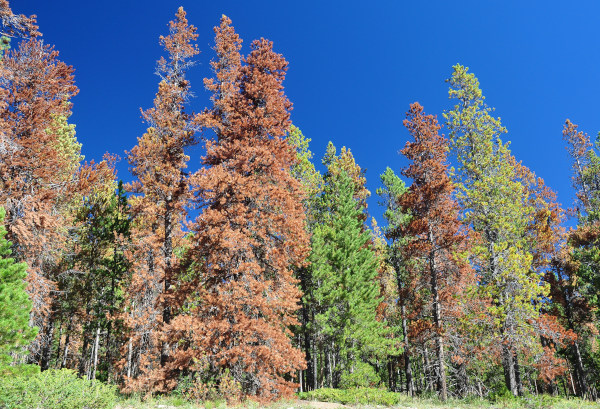
Fading or Discoloring Needles
Healthy green needles that turn yellowish, then rusty red. By the time an entire crown is red, the beetles have typically already exited the tree and moved to new hosts.
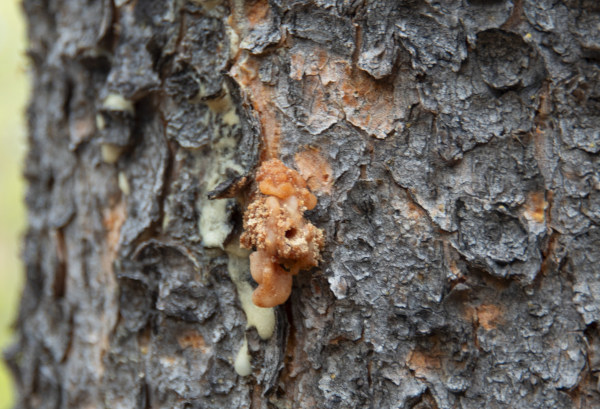
Pitch Tubes on the Trunk
Small, popcorn-shaped masses of resin on the bark surface. These form when the tree tries to "pitch out" boring beetles. Reddish-brown pitch tubes indicate a failed defense.
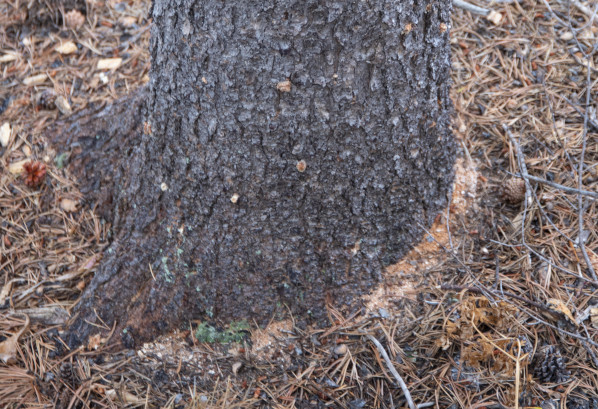
Boring Dust (Frass)
Fine, reddish-brown sawdust accumulating in bark crevices, around the base of the tree, and on spider webs nearby. This indicates active beetle tunneling beneath the bark.
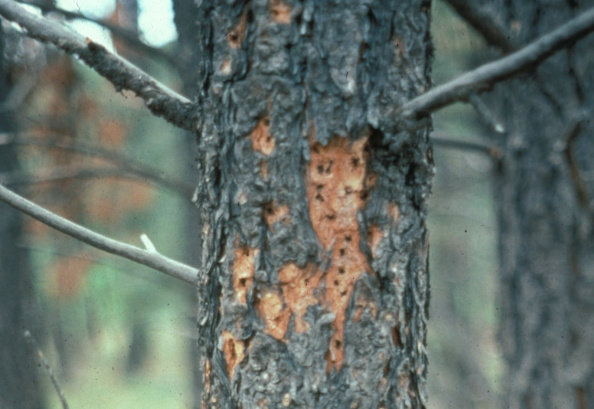
Woodpecker Activity
Heavy woodpecker feeding on trunk and branches strips bark as they search for beetle larvae. Large patches of light-colored, exposed wood are a telltale sign of severe infestation.
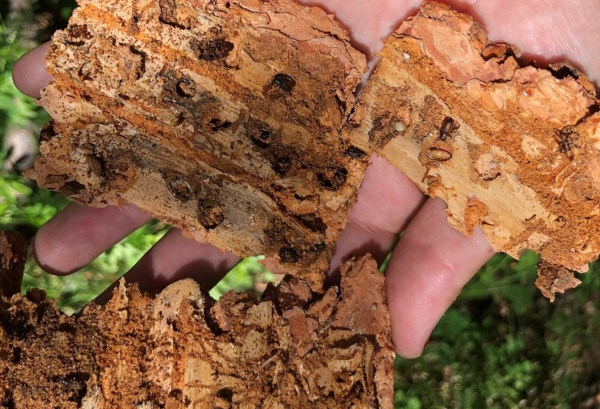
J-Shaped Galleries Under Bark
Peel back a small section of loose bark to reveal tunneling patterns. Mountain pine beetles create distinctive J- or Y-shaped egg galleries carved into the inner bark.
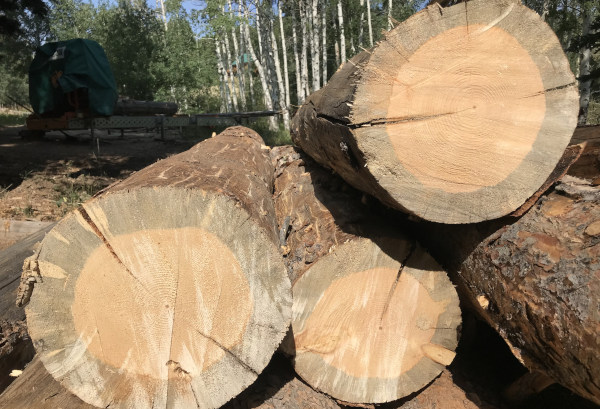
Blue Stain Fungus
Beetles carry blue stain fungus that blocks the tree's water-conducting tissues. Cross-cut sections of affected wood show distinctive blue-gray streaking through the sapwood.
Photos: Colorado State Forest Service
Latest from the Blog
View All →
Colorado's 2026 Pine Beetle Response: Task Force, Funding, and What It Means for Homeowners
Governor Polis created a statewide task force, Jefferson County launched a $500K cost-share program, and the legislature is funding biological controls. Here's what Colorado is actually doing about the pine beetle outbreak — and what homeowners need to know.

Colorado's Ponderosa Mountain Pine Beetle Task Force: What It Is, Who's Behind It, and What It Means for the Front Range
Colorado's Ponderosa Mountain Pine Beetle Task Force was created to fight the expanding Front Range outbreak. Here's what the task force is doing and what it means for you.