
Pine Beetle Prevention in Boulder, Colorado
Protect your trees from bark beetle infestations in Boulder, Boulder County. Local prevention tips, risk assessment, and professional resources.
Elevation
5,430'
Population
108,250
County
Boulder
Primary Trees
Ponderosa Pine
CSFS Mountain Pine Beetle Activity — Boulder County
Documented
Active beetles in county
Adjacent
Nearby activity
Not Documented
No confirmed activity
Source: Colorado State Forest Service aerial surveys, 2024
Mountain Pine Beetle in Boulder County
Boulder County is experiencing an intensifying MPB outbreak, particularly in Upper Lefthand Canyon and the Jamestown area, with foothills forests expected to look markedly different by late 2026.
Boulder County Details
The Boulder Reporting Lab documented the outbreak's rapid expansion in February 2026. Community concern is heightened following the Marshall Fire experience, as beetle-killed trees add to fuel loads in WUI areas. State Representative Lesley Smith (Boulder) serves on the Pine Beetle Task Force.
Key Finding
Upper Lefthand Canyon and Jamestown area identified as rapidly intensifying outbreak zones
Front Range Outbreak Trend
Acres of MPB-caused tree mortality, Front Range. Source: CSFS Aerial Surveys, 2020–2024
700K+
Acres of vulnerable pine along the Front Range
1,767%
Increase in affected acres, 2020–2024
Data sourced from Colorado State Forest Service aerial survey reports, forest health publications, and local reporting.
Pine Beetle Guide for Boulder, Colorado
Boulder is a city of over 108,000 residents in Boulder County, situated at 5,430 feet where the dramatic Flatiron rock formations signal the abrupt transition from the Great Plains to the Rocky Mountain foothills. The city's western boundary climbs steeply into the Boulder Mountain Parks — over 46,000 acres of city-owned open space and mountain parkland — creating one of the most extensive urban-wildland interfaces in the American West. Ponderosa Pine dominates the foothills landscape above the city, covering the slopes of Flagstaff Mountain, Green Mountain, Bear Peak, and the ridges extending westward toward Nederland and the Indian Peaks Wilderness. Boulder's strong environmental ethic and extensive open space holdings create a community deeply invested in forest health — and one where pine beetle management carries both ecological and emotional weight.
Pine Beetle Risk in Boulder
Boulder is rated High for pine beetle risk, reflecting the substantial threat posed by beetle activity in its extensive mountain park system and foothill neighborhoods.
Boulder's risk profile is driven by a striking geographic dichotomy. The city proper, spread across the plains at 5,430 feet, has minimal Ponderosa Pine and low beetle risk. But Boulder's western boundary rises rapidly to elevations of 7,000 to 8,500 feet within just a few miles, and these mountain foothills — which Boulder owns and manages as mountain parkland — contain tens of thousands of Ponderosa Pines in dense, beetle-susceptible stands. The "High" rating reflects the average across this gradient; the mountain parks themselves face Critical-level risk.
Boulder Mountain Parks and the adjacent Boulder County Open Space lands contain Ponderosa Pine forests that have experienced significant beetle activity over the past two decades. The 2009-2012 mountain pine beetle epidemic killed thousands of trees on Flagstaff Mountain, along the Sanitas Trail corridor, and in the foothills west of town. The standing dead timber from that event remains visible on the skyline and continues to influence beetle populations and wildfire risk.
The residential neighborhoods that interface with the mountain parks — including Chautauqua, Sunshine Canyon, Fourmile Canyon, Pine Brook Hills, and the communities along Flagstaff Road — are deeply embedded in Ponderosa Pine forest. These neighborhoods face beetle pressure equivalent to mountain communities at similar elevations, compounded by the dense forest of the surrounding parkland.
Boulder's precipitation patterns are influenced by its position at the base of the Continental Divide. While the city receives more annual precipitation than most Front Range communities, the foothills immediately above town can be significantly drier on south-facing exposures. The persistent upslope conditions that bring moisture to Boulder often bypass the steeper, south-facing slopes where Ponderosa Pine is densest — precisely the areas most vulnerable to beetle attack.
The 2010 Fourmile Canyon Fire, which destroyed 169 homes and burned 6,181 acres of forest northwest of Boulder, highlighted the beetle-fire connection in the community. Beetle-killed trees contributed to fuel loading in the fire area, and the fire's aftermath left stressed surviving trees more susceptible to subsequent beetle attack.
Prevention Tips for Boulder Properties
Boulder's prevention strategy must navigate the city's regulatory environment, environmental values, and the unique challenge of private properties embedded in vast public forest.
Coordinate with OSMP Forest Management: Boulder's Open Space and Mountain Parks department conducts active forest health management including beetle monitoring, infested tree removal, and prescribed burning on city-owned land. If your property borders OSMP land, this coordination is your most important prevention tool. Contact the OSMP forest management team for information on current beetle conditions adjacent to your property, upcoming management activities, and how your private-land management can complement their work. OSMP's forest health plans operate on multi-year cycles — understanding their timeline helps you plan your own activities.
Foothill Properties — Defensible Space with Boulder Character: Boulder's land use regulations include wildfire mitigation provisions for interface properties, but the community's strong environmental ethic means thinning must be done thoughtfully. Work with the Boulder Fire-Rescue Wildfire Division for a free property assessment that balances beetle and fire prevention with Boulder's landscape values. Thin Ponderosa stands to 50 to 70 trees per acre around structures, focusing on removing suppressed and damaged individuals while preserving the largest, healthiest trees. In Boulder's regulatory environment, document your management rationale before beginning work — this protects you if neighbors or officials question tree removal.
Spring Drought Watering: Boulder's unique climate pattern creates a specific vulnerability window. While the city receives decent annual precipitation overall, the March through May period can be extremely dry, leaving trees moisture-depleted right before beetle flight season. For valued foothill Ponderosas, targeted spring watering — a deep soak in March, April, and May during dry springs — builds pitch reserves at the critical time. This seasonal focus provides more beetle prevention per gallon of water than a standard monthly summer schedule. Deliver water at the drip line via soaker hose for four to six hours per session.
Pruning and Slash Within Boulder's Regulatory Framework: Boulder's environmental regulations affect tree work in many areas. Prune Ponderosa Pine only between November and March. Before any tree removal or significant thinning, check city requirements — some zones require permits. After any work, remove all slash from the property immediately. Boulder County coordinates periodic community slash collection events; schedule your work to align with these windows.
Preventive Treatment for Interface Properties: For high-value Ponderosas in the foothill neighborhoods closest to mountain parkland, annual preventive bark sprays applied in late April to mid-May offer reliable individual-tree protection. Work with a licensed applicator experienced in Boulder's terrain and familiar with the city's environmental standards. Some Boulder neighborhoods have organized collective treatment programs — check with your neighbors before arranging individual service, as a group contract may already exist.
Local Resources
- Boulder Open Space and Mountain Parks (OSMP) manages over 46,000 acres of city-owned open space with active forest health programs. They are the primary public land manager affecting Boulder's beetle conditions and the most important coordination partner for interface property owners. Their forestry staff are accessible and knowledgeable.
- Boulder Fire-Rescue Wildfire Division provides free wildfire mitigation assessments that integrate beetle management for interface properties. Their assessment reports carry weight with neighbors and officials if you need to justify thinning.
- Boulder County Parks and Open Space manages additional open space in the Boulder area with its own forest health monitoring programs.
- Colorado State Forest Service — Boulder District provides technical assistance, forest management planning, and cost-sharing programs for private landowners in Boulder County.
- Roosevelt National Forest manages federal land west and north of Boulder and monitors beetle conditions that affect the broader mountain forest.
- City of Boulder Forestry Division manages city-owned street and park trees and advises on urban tree health issues.
- University of Colorado Environmental Center conducts research on local forest ecology including bark beetle dynamics, producing data that informs community management decisions.
Nearby Affected Areas
Boulder's beetle risk connects to both mountain and foothill communities. Lyons to the north shares Boulder County and faces High risk in its foothill setting. Estes Park to the northwest, at over 7,500 feet, faces Critical beetle risk in its dense mountain forest. Golden to the south shares a foothills setting and Moderate risk. Evergreen and Conifer to the southwest carry Critical risk in their mountain forests. Fort Collins and Loveland to the north face Moderate risk as larger urban communities with foothills interfaces. The mountain forests west of Boulder — from the Indian Peaks to Rocky Mountain National Park — have experienced significant beetle activity that influences pressure on Boulder's mountain park forests.
Common Pine Beetle Species in Colorado
Three bark beetle species pose the greatest threat to pine trees in Boulder and across Colorado's Front Range.
Mountain Pine Beetle
Dendroctonus ponderosae
The primary killer of Ponderosa and Lodgepole pines along the Front Range. Adults are black, about the size of a grain of rice (5mm). They use aggregation pheromones to coordinate mass attacks that overwhelm a tree's pitch defenses.
- ● Targets trees 8"+ diameter
- ● One generation per year (July–August flight)
- ● Carries blue stain fungus that blocks water transport
- ● Creates J-shaped egg galleries under bark
Ips Engraver Beetle
Ips pini
A smaller, opportunistic beetle that exploits any weakness: drought stress, pruning wounds, fresh slash piles, or construction damage to roots. Less dramatic than MPB but persistent and hard to prevent entirely.
- ● Attacks trees of any size, including limbs
- ● 2–3 generations per year (April–October)
- ● Creates Y-shaped egg galleries under bark
- ● Often the first beetle to attack stressed trees
Red Turpentine Beetle
Dendroctonus valens
The largest bark beetle in North America (up to 10mm). Typically attacks the lower trunk of weakened or injured trees. Rarely kills trees on its own but signals stress that can attract MPB and Ips beetles.
- ● Attacks lower 6 feet of trunk
- ● Produces large, quarter-sized pitch tubes
- ● Indicator species for tree stress
- ● Often found after construction or root damage
Species data: Colorado State Forest Service, USDA Forest Service
Signs of Pine Beetle Infestation
Knowing what to look for is the first step to protecting your Boulder property. Here are the key warning signs every homeowner should monitor.
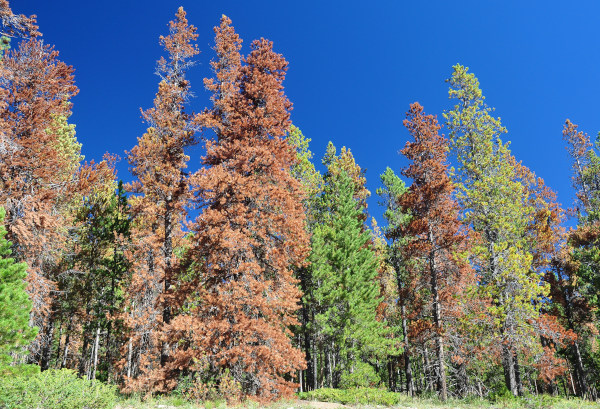
Fading or Discoloring Needles
Healthy green needles that turn yellowish, then rusty red. By the time an entire crown is red, the beetles have typically already exited the tree and moved to new hosts.
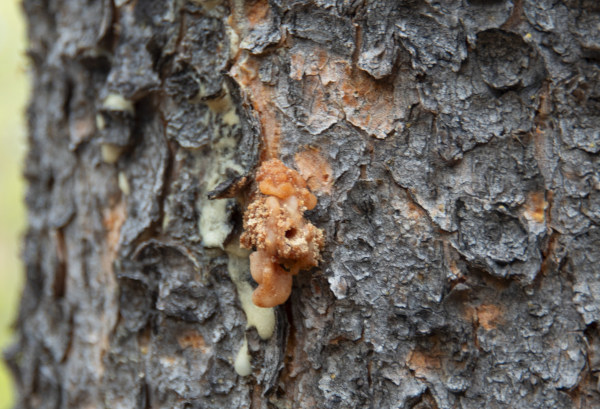
Pitch Tubes on the Trunk
Small, popcorn-shaped masses of resin on the bark surface. These form when the tree tries to "pitch out" boring beetles. Reddish-brown pitch tubes indicate a failed defense.
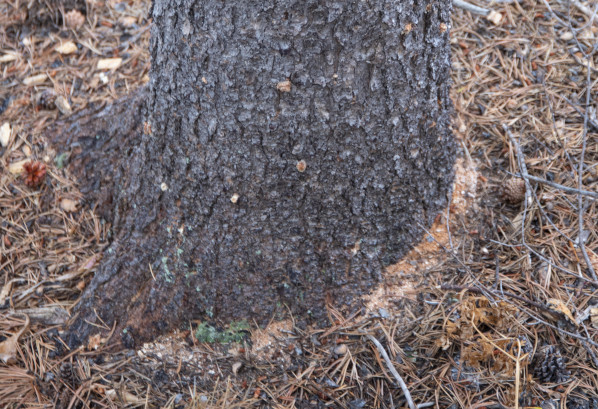
Boring Dust (Frass)
Fine, reddish-brown sawdust accumulating in bark crevices, around the base of the tree, and on spider webs nearby. This indicates active beetle tunneling beneath the bark.
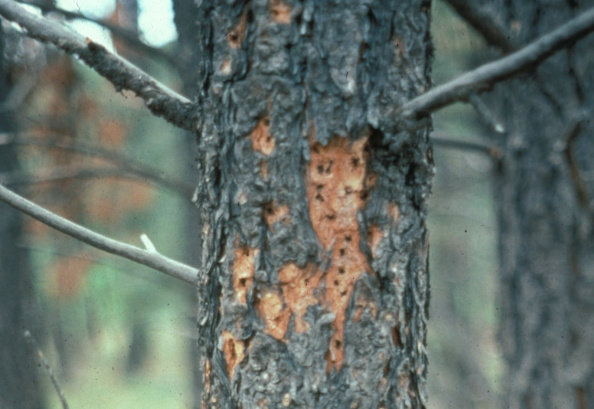
Woodpecker Activity
Heavy woodpecker feeding on trunk and branches strips bark as they search for beetle larvae. Large patches of light-colored, exposed wood are a telltale sign of severe infestation.
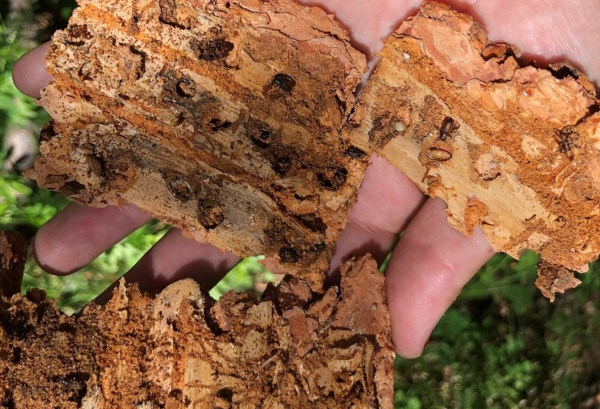
J-Shaped Galleries Under Bark
Peel back a small section of loose bark to reveal tunneling patterns. Mountain pine beetles create distinctive J- or Y-shaped egg galleries carved into the inner bark.
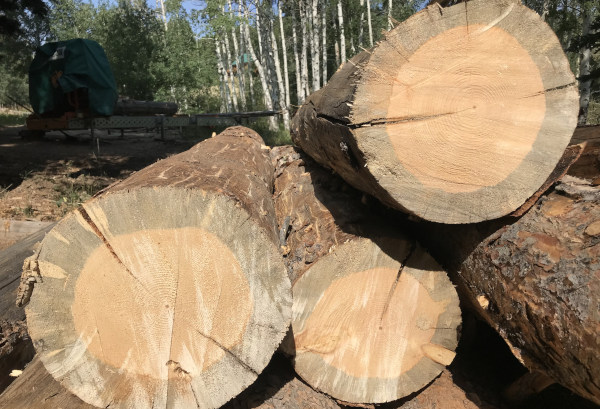
Blue Stain Fungus
Beetles carry blue stain fungus that blocks the tree's water-conducting tissues. Cross-cut sections of affected wood show distinctive blue-gray streaking through the sapwood.
Photos: Colorado State Forest Service
Nearby Front Range Communities
Latest from the Blog
View All →
Colorado's 2026 Pine Beetle Response: Task Force, Funding, and What It Means for Homeowners
Governor Polis created a statewide task force, Jefferson County launched a $500K cost-share program, and the legislature is funding biological controls. Here's what Colorado is actually doing about the pine beetle outbreak — and what homeowners need to know.

Colorado's Ponderosa Mountain Pine Beetle Task Force: What It Is, Who's Behind It, and What It Means for the Front Range
Colorado's Ponderosa Mountain Pine Beetle Task Force was created to fight the expanding Front Range outbreak. Here's what the task force is doing and what it means for you.