
Pine Beetle Prevention in Colorado Springs, Colorado
Protect your trees from bark beetle infestations in Colorado Springs, El Paso County. Local prevention tips, risk assessment, and professional resources.
Elevation
6,035'
Population
488,664
County
El Paso
Primary Trees
Ponderosa Pine
CSFS Mountain Pine Beetle Activity — El Paso County
Documented
Active beetles in county
Adjacent
Nearby activity
Not Documented
No confirmed activity
Source: Colorado State Forest Service aerial surveys, 2024
Mountain Pine Beetle in El Paso County
El Paso County represents the southern extent of the Front Range MPB outbreak, with documented beetle activity in ponderosa pine forests from Black Forest through Monument and into the western foothills near Colorado Springs.
El Paso County Details
The 2013 Black Forest Fire already demonstrated the catastrophic fire risk in El Paso County's pine forests. Now beetle-killed trees are adding to fuel loads in the same communities. Teller County Commissioner Dan Williams, from neighboring Cripple Creek, serves on the state Pine Beetle Task Force.
Key Finding
Southern extent of the Front Range outbreak; compounding fire risk from 2013 Black Forest Fire legacy
Front Range Outbreak Trend
Acres of MPB-caused tree mortality, Front Range. Source: CSFS Aerial Surveys, 2020–2024
700K+
Acres of vulnerable pine along the Front Range
1,767%
Increase in affected acres, 2020–2024
Data sourced from Colorado State Forest Service aerial survey reports, forest health publications, and local reporting.
Pine Beetle Guide for Colorado Springs, Colorado
Colorado Springs is the second-largest city in Colorado, home to nearly 489,000 residents spread across a dramatic landscape at the base of Pikes Peak at 6,035 feet. The city stretches from open prairie grasslands on its eastern fringe to steep, forested foothills on its western edge, with the iconic Garden of the Gods, North Cheyenne Canyon, and the Broadmoor area providing some of the most striking mountain-urban interfaces in the American West. Ponderosa Pine is the dominant conifer across the city's western neighborhoods, blanketing the foothills from the Air Force Academy in the north to Cheyenne Mountain in the south. With rapid westward residential expansion pushing deeper into forested terrain, Colorado Springs faces a growing and complex pine beetle challenge that affects hundreds of thousands of trees across its western corridor.
Pine Beetle Risk in Colorado Springs
Colorado Springs is rated High for pine beetle risk, reflecting the substantial but geographically varied threat across this sprawling city.
The city's elevation ranges from approximately 5,800 feet on the eastern plains to over 7,500 feet in the western foothills, creating a gradient of beetle risk. The eastern portions of the city — Cimarron Hills, Powers corridor, Stetson Hills — have minimal Ponderosa Pine and negligible beetle risk. The western foothills neighborhoods — Skyway, Crystal Park, Cheyenne Canon, Broadmoor Bluffs, Peregrine, Mountain Shadows, and the Rockrimmon area — sit within dense Ponderosa Pine forest and face beetle pressure comparable to Critical-rated communities.
The Waldo Canyon Fire of 2012 devastated the Mountain Shadows neighborhood, burning through beetle-weakened Ponderosa Pine stands and destroying 347 homes. That fire catalyzed community-wide awareness of the connection between beetle-killed trees and wildfire risk. In the years since, Colorado Springs has invested heavily in forest health management through its Fire Mitigation and Forestry programs, but the scope of the challenge — hundreds of thousands of Ponderosas across the western corridor — exceeds any single program's capacity.
Colorado Springs' western foothills receive somewhat more precipitation than the Palmer Divide communities to the north, benefiting from orographic lift against the Pikes Peak massif. However, the rain shadow on certain south-facing slopes creates localized drought stress pockets where beetle activity concentrates. The 2018 and 2020 drought years produced significant beetle-related Ponderosa mortality in the Mountain Shadows regrowth area, along Gold Camp Road, and in the Bear Creek corridor.
The city's soils vary dramatically. Western foothill soils are thin, rocky, and granitic — fast-draining and drought-prone. Central and eastern soils include deeper clay and loam formations that retain more moisture. Ponderosas growing on the western granitic soils face substantially more drought stress than those growing in irrigated landscapes at lower elevations.
Prevention Tips for Colorado Springs Properties
Colorado Springs' scale and diversity demand different prevention strategies for different parts of the city — a foothill property and a Rockrimmon lot require fundamentally different approaches.
Foothills Properties — Integrate Fire and Beetle Prevention: The 2012 Waldo Canyon Fire taught Colorado Springs that beetle management and wildfire mitigation are inseparable. Properties in the western foothills should implement defensible space standards that simultaneously create beetle-resistant conditions. Colorado Springs Fire Department's Wildfire Mitigation Division offers free property assessments — take advantage of this service. Their foresters will walk your property and provide a customized plan that addresses both risks. Thinning to create defensible space zones automatically reduces tree competition and improves individual tree vigor against beetles.
Urban Properties — Reduce the Stress Catalog: For Ponderosa Pines in developed neighborhoods, the primary prevention strategy is eliminating the chronic stressors that weaken trees into beetle targets. Protect root zones from compaction — no foot traffic, no parked cars, no stored materials under the canopy. Maintain a mulch ring three to four inches deep from trunk to drip line to moderate soil temperature and retain moisture. Deep-water monthly during dry periods using a soaker hose at the drip line rather than relying on turf sprinklers. Colorado Springs Utilities' water conservation guidelines include specific provisions for supplemental tree irrigation that allow deep-root watering even during restrictions.
Community-Organized Spray Programs in Foothill Neighborhoods: Several Mountain Shadows and Skyway neighborhood associations have established annual collective beetle spraying programs, contracting with licensed applicators to treat participating properties during the late April to late May window. These community programs reduce per-tree costs and improve area-wide coverage. If your foothill neighborhood lacks such a program, contact your HOA about establishing one. The economies of scale make the difference between affordable annual prevention and prohibitively expensive individual treatment.
Rapid Dead Tree Removal as Community Safety: Colorado Springs' Waldo Canyon experience proved that beetle-killed trees are wildfire fuel. Every dead Ponderosa standing in a foothill neighborhood is both a beetle source and a fire hazard. The city's Forestry Division handles trees on public property, but private property owners are responsible for their own dead tree removal. Several city programs provide financial assistance for low-income homeowners who need help with removal costs. Check with the city's Community Development Division for current assistance availability.
Citywide Pruning Standards: Prune Ponderosa Pine only between November 1 and March 15 — no exceptions. This standard is codified in some Colorado Springs HOA covenants and should be universal practice. If you hire a tree service, verify their understanding of seasonal timing. If you see a commercial crew pruning pines in summer, contact the property management — educating one landscape company can prevent beetle outbreaks across multiple neighborhoods.
Local Resources
- Colorado Springs Fire Department — Wildfire Mitigation Division provides free property assessments, defensible space planning, and community wildfire preparedness programs that directly integrate beetle management. This is the single best starting point for any Colorado Springs homeowner concerned about beetle risk.
- Colorado Springs Forestry Division manages city-owned trees and coordinates urban forest health programs. Report dead or declining trees on city property through their department.
- Colorado Springs Utilities manages watershed lands west of the city, including beetle monitoring in the Pikes Peak watershed that supplies the city's water. Their water conservation team can advise on tree watering during drought restrictions.
- Pikes Peak Wildfire Prevention Partners is a coalition of agencies and organizations coordinating wildfire and forest health initiatives across the region. They publish seasonal conditions reports and educational materials.
- El Paso County Wildfire Mitigation Program extends city programs to unincorporated properties surrounding Colorado Springs.
- Pike National Forest — Pikes Peak Ranger District manages the vast federal forest immediately west of the city and provides current beetle condition reports.
- Colorado State Forest Service provides technical assistance and cost-sharing programs for private landowners throughout the Pikes Peak region.
Nearby Affected Areas
Colorado Springs' beetle risk is connected to a web of Front Range communities. To the north, Monument and Palmer Lake carry Critical risk ratings in their densely forested Palmer Divide setting. Black Forest to the northeast — recovering from the 2013 fire — faces Critical risk in its remaining and regenerating Ponderosa forests. Woodland Park to the west, at over 8,400 feet, experiences some of the Front Range's most intense mountain pine beetle pressure. The entire Pikes Peak region represents an interconnected forest system where beetle populations build and disperse across community boundaries, making regional cooperation essential.
Common Pine Beetle Species in Colorado
Three bark beetle species pose the greatest threat to pine trees in Colorado Springs and across Colorado's Front Range.
Mountain Pine Beetle
Dendroctonus ponderosae
The primary killer of Ponderosa and Lodgepole pines along the Front Range. Adults are black, about the size of a grain of rice (5mm). They use aggregation pheromones to coordinate mass attacks that overwhelm a tree's pitch defenses.
- ● Targets trees 8"+ diameter
- ● One generation per year (July–August flight)
- ● Carries blue stain fungus that blocks water transport
- ● Creates J-shaped egg galleries under bark
Ips Engraver Beetle
Ips pini
A smaller, opportunistic beetle that exploits any weakness: drought stress, pruning wounds, fresh slash piles, or construction damage to roots. Less dramatic than MPB but persistent and hard to prevent entirely.
- ● Attacks trees of any size, including limbs
- ● 2–3 generations per year (April–October)
- ● Creates Y-shaped egg galleries under bark
- ● Often the first beetle to attack stressed trees
Red Turpentine Beetle
Dendroctonus valens
The largest bark beetle in North America (up to 10mm). Typically attacks the lower trunk of weakened or injured trees. Rarely kills trees on its own but signals stress that can attract MPB and Ips beetles.
- ● Attacks lower 6 feet of trunk
- ● Produces large, quarter-sized pitch tubes
- ● Indicator species for tree stress
- ● Often found after construction or root damage
Species data: Colorado State Forest Service, USDA Forest Service
Signs of Pine Beetle Infestation
Knowing what to look for is the first step to protecting your Colorado Springs property. Here are the key warning signs every homeowner should monitor.
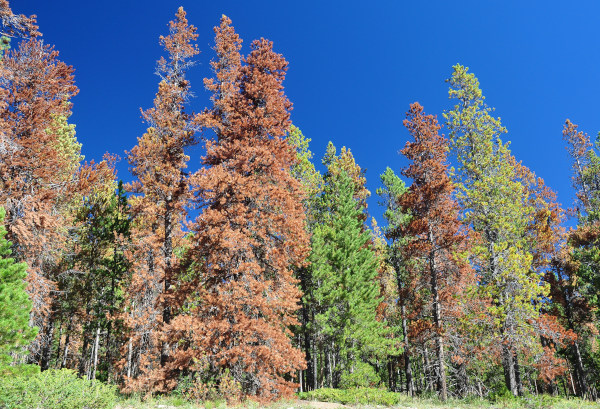
Fading or Discoloring Needles
Healthy green needles that turn yellowish, then rusty red. By the time an entire crown is red, the beetles have typically already exited the tree and moved to new hosts.
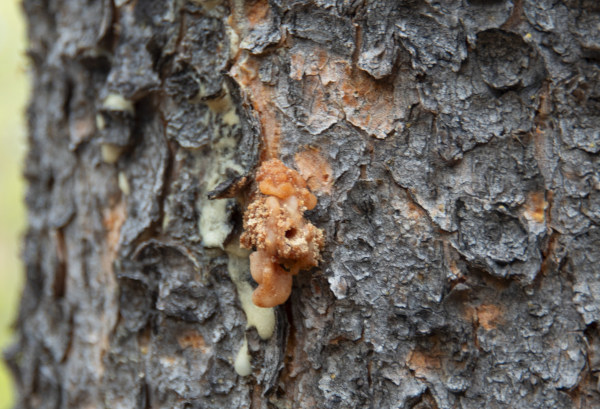
Pitch Tubes on the Trunk
Small, popcorn-shaped masses of resin on the bark surface. These form when the tree tries to "pitch out" boring beetles. Reddish-brown pitch tubes indicate a failed defense.
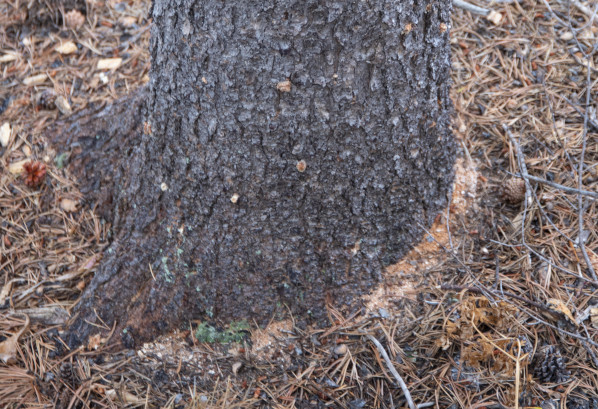
Boring Dust (Frass)
Fine, reddish-brown sawdust accumulating in bark crevices, around the base of the tree, and on spider webs nearby. This indicates active beetle tunneling beneath the bark.
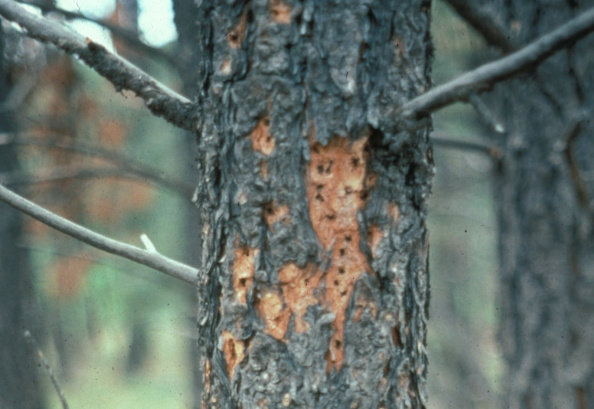
Woodpecker Activity
Heavy woodpecker feeding on trunk and branches strips bark as they search for beetle larvae. Large patches of light-colored, exposed wood are a telltale sign of severe infestation.
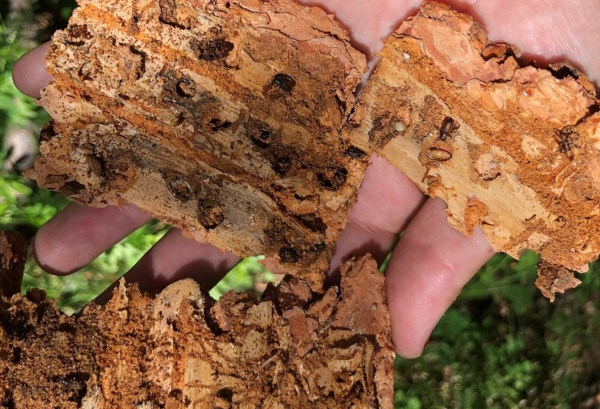
J-Shaped Galleries Under Bark
Peel back a small section of loose bark to reveal tunneling patterns. Mountain pine beetles create distinctive J- or Y-shaped egg galleries carved into the inner bark.
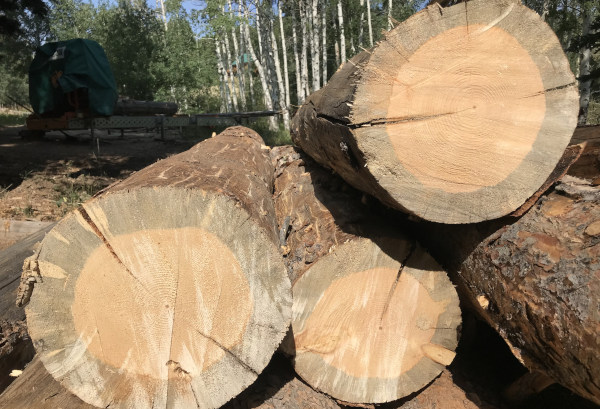
Blue Stain Fungus
Beetles carry blue stain fungus that blocks the tree's water-conducting tissues. Cross-cut sections of affected wood show distinctive blue-gray streaking through the sapwood.
Photos: Colorado State Forest Service
Nearby Front Range Communities
Latest from the Blog
View All →
Colorado's 2026 Pine Beetle Response: Task Force, Funding, and What It Means for Homeowners
Governor Polis created a statewide task force, Jefferson County launched a $500K cost-share program, and the legislature is funding biological controls. Here's what Colorado is actually doing about the pine beetle outbreak — and what homeowners need to know.

Colorado's Ponderosa Mountain Pine Beetle Task Force: What It Is, Who's Behind It, and What It Means for the Front Range
Colorado's Ponderosa Mountain Pine Beetle Task Force was created to fight the expanding Front Range outbreak. Here's what the task force is doing and what it means for you.