
Pine Beetle Prevention in Black Forest, Colorado
Protect your trees from bark beetle infestations in Black Forest, El Paso County. Local prevention tips, risk assessment, and professional resources.
Elevation
7,200'
Population
15,000
County
El Paso
Primary Trees
Ponderosa Pine
CSFS Mountain Pine Beetle Activity — El Paso County
Documented
Active beetles in county
Adjacent
Nearby activity
Not Documented
No confirmed activity
Source: Colorado State Forest Service aerial surveys, 2024
Mountain Pine Beetle in El Paso County
El Paso County represents the southern extent of the Front Range MPB outbreak, with documented beetle activity in ponderosa pine forests from Black Forest through Monument and into the western foothills near Colorado Springs.
El Paso County Details
The 2013 Black Forest Fire already demonstrated the catastrophic fire risk in El Paso County's pine forests. Now beetle-killed trees are adding to fuel loads in the same communities. Teller County Commissioner Dan Williams, from neighboring Cripple Creek, serves on the state Pine Beetle Task Force.
Key Finding
Southern extent of the Front Range outbreak; compounding fire risk from 2013 Black Forest Fire legacy
Front Range Outbreak Trend
Acres of MPB-caused tree mortality, Front Range. Source: CSFS Aerial Surveys, 2020–2024
700K+
Acres of vulnerable pine along the Front Range
1,767%
Increase in affected acres, 2020–2024
Data sourced from Colorado State Forest Service aerial survey reports, forest health publications, and local reporting.
Pine Beetle Guide for Black Forest, Colorado
Black Forest is an unincorporated community of approximately 15,000 residents in northeastern El Paso County, situated at 7,200 feet on a broad, gently rolling mesa east of the Palmer Divide. The community's name tells its story — Black Forest is defined by its dense, dark stands of Ponderosa Pine that cover the landscape in one of the most extensive pine forests on the Colorado Front Range. Unlike the mountain communities where pine forest climbs steep hillsides, Black Forest's trees grow on a relatively flat, high-elevation plateau, creating a unique forest environment more reminiscent of the Black Hills of South Dakota than of the Colorado Rockies. This distinctive landscape was forever altered by the 2013 Black Forest Fire — the most destructive wildfire in Colorado history at the time — which burned 14,280 acres and destroyed 489 homes. The community's ongoing recovery from that catastrophic event shapes every aspect of its current pine beetle management challenge.
Pine Beetle Risk in Black Forest
Black Forest holds a Critical pine beetle risk designation, driven by the combination of its naturally dense Ponderosa Pine forest, high elevation, and the transformative impact of the 2013 fire.
At 7,200 feet, Black Forest sits in the optimal elevation band for mountain pine beetle activity in Ponderosa Pine. The community's unique geographic character — a flat-topped mesa covered in dense pine rather than the typical slope-and-canyon terrain of most Front Range forest — creates forest conditions that can sustain large beetle populations. The flat terrain means water does not drain away quickly, but the soils — deep, sandy loam over weathered Dawson Arkose sandstone — are so well-drained that moisture percolates below the root zone rapidly, leaving trees drought-stressed despite the community's modest topographic relief.
The 2013 fire divided Black Forest into two distinct beetle management zones. The burned area — approximately 14,000 acres — lost its mature Ponderosa Pine canopy entirely. Regrowth is occurring both through natural regeneration and replanting, and these young trees are now entering the size class where beetle attack becomes possible, though they remain less vulnerable than mature trees for several more years. The unburned areas — which make up the majority of the community — retained their dense, mature Ponderosa Pine stands and face immediate, severe beetle risk.
The fire's lasting impact extends beyond the burn perimeter. Trees on the edges of the burn area experienced heat stress, crown scorch, and root damage that weakened them without killing them outright. These fire-stressed trees have been preferentially targeted by bark beetles in the years since 2013, creating a halo of beetle mortality around portions of the burn scar. Additionally, the loss of the burned area's forest canopy altered local wind patterns and humidity, potentially increasing drought stress on surviving trees in adjacent unburned areas.
Black Forest's pre-fire forest density was extraordinary — many areas exceeded 200 trees per acre, with canopy closure so complete that the forest floor received minimal sunlight. This overcrowding, the product of more than a century of fire suppression, left every tree competing for limited water and nutrients. The unburned portions of Black Forest retain these unsustainable densities, creating ideal conditions for bark beetle outbreaks.
The community lacks public water infrastructure — all properties rely on individual wells drawing from the Dawson Aquifer. Water table levels in parts of the aquifer have been declining, which affects both residential water availability and the hydrology supporting tree root systems.
Prevention Tips for Black Forest Properties
Black Forest's post-fire reality demands a prevention approach that integrates beetle management, wildfire preparedness, and aquifer-dependent water conservation into a single strategy.
Thinning as the Non-Negotiable Priority: The unburned portions of Black Forest must be thinned. Period. The community's pre-fire densities of 150 to 200+ trees per acre are fundamentally unsustainable — they guarantee eventual mortality through either beetles, fire, or both. The target is 50 to 60 trees per acre in the immediate defensible space zone and 60 to 80 per acre in the broader forest. This means removing 50 to 70 percent of standing trees — a dramatic change that alters the forest character many residents moved here for. But the biological reality is that an unthinned Black Forest stand is a dying stand on a timescale of years, not decades. Work with a professional forester to develop a science-based plan. Black Forest Together, the community nonprofit formed after the fire, provides support and coordination for thinning efforts.
Integrated Fire-Beetle Defensible Space: The 2013 fire demonstrated catastrophically what happens when dense forest meets ignition. Every defensible space action simultaneously addresses beetle vulnerability. Zone 1 (0 to 15 feet from structures): lean landscape with no pine canopy directly overhead. Zone 2 (15 to 100 feet): thinned to 50 to 60 trees per acre, all dead trees removed, no slash on the ground. Zone 3 (100 to 200 feet): thinned to 60 to 80 trees per acre with ground fuels managed. The El Paso County Wildfire Mitigation Program and Black Forest Fire/Rescue Protection District both provide free defensible space assessments — use them.
Community Slash Infrastructure: Black Forest has built exemplary community slash management infrastructure in response to the fire and beetle threats. The Black Forest Together organization operates a community slash and mulch site where residents dispose of tree material free of charge. The site converts slash into mulch that residents can then use for landscape improvement. Use this resource — it eliminates the excuse for leaving slash on your property during warm months. Every slash pile left on-site between April and September is an active beetle breeding facility that undermines your thinning investment.
Well Water Budgeting for Tree Priority: Black Forest's complete dependence on individual wells from the Dawson Aquifer creates hard limits on supplemental tree watering. You cannot irrigate the forest, and you should not try. Instead, identify the 10 to 15 highest-value Ponderosas closest to your home — the trees that provide shade, privacy, and windbreak — and allocate your water budget exclusively to them. A soaker hose at the drip line delivering a slow soak monthly during dry periods builds the moisture reserves these trees convert to defensive pitch. During severe drought when well capacity may be limited, consider rainwater harvesting systems to supplement well water for tree irrigation. The math is straightforward: losing 15 mature Ponderosas to beetles costs far more in property value and replacement than the water invested in keeping them alive.
Preventive Spraying Along Mortality Fronts: If active beetle mortality is visible within 500 feet of your property, preventive bark sprays for your nearest Ponderosas are urgent, not optional. Apply carbaryl between mid-April and late May, covering trunks from ground level to the base of the live crown. Black Forest's flat terrain and limited wind exposure allow for more uniform spray coverage than mountain sites. Concentrate treatment on the trees in the path of the advancing mortality pocket rather than spraying your entire property.
Local Resources
- Black Forest Together is the community nonprofit formed after the 2013 fire that has become the most active grassroots forest management organization on the Front Range. They operate the community slash and mulch site, coordinate neighborhood thinning efforts, provide community education, and connect residents with contractors and funding sources. If you are a Black Forest property owner, engage with Black Forest Together.
- Black Forest Fire/Rescue Protection District provides defensible space assessments, coordinates community wildfire preparedness, and integrates beetle management with fire prevention. Their knowledge of Black Forest's post-fire landscape is invaluable.
- El Paso County Wildfire Mitigation Program provides free property assessments, defensible space planning, and connects residents with cost-sharing programs for thinning and treatment.
- Colorado State Forest Service offers technical assistance, forest management planning for larger properties, and cost-sharing grants that can significantly reduce thinning costs.
- El Paso County Environmental Services coordinates natural resource management for unincorporated El Paso County, including forest health components.
- Black Forest Land Trust supports conservation and responsible land management in the community, with programs that include forest health stewardship.
Nearby Affected Areas
Black Forest's beetle risk is connected to the broader Pikes Peak region forest. Colorado Springs borders Black Forest to the south and west, with its western foothills neighborhoods facing High beetle risk. Monument to the west carries Critical risk on the Palmer Divide, and beetle populations can move between Monument's forested corridor and Black Forest's plateau forest. Palmer Lake to the northwest sits at even higher elevation with Critical risk. The 2013 Black Forest Fire demonstrated how interconnected these communities are — beetle-weakened forests burn more intensely, and fire-stressed forests attract more beetles. Managing this cycle requires coordination across the entire northeastern El Paso County landscape.
Common Pine Beetle Species in Colorado
Three bark beetle species pose the greatest threat to pine trees in Black Forest and across Colorado's Front Range.
Mountain Pine Beetle
Dendroctonus ponderosae
The primary killer of Ponderosa and Lodgepole pines along the Front Range. Adults are black, about the size of a grain of rice (5mm). They use aggregation pheromones to coordinate mass attacks that overwhelm a tree's pitch defenses.
- ● Targets trees 8"+ diameter
- ● One generation per year (July–August flight)
- ● Carries blue stain fungus that blocks water transport
- ● Creates J-shaped egg galleries under bark
Ips Engraver Beetle
Ips pini
A smaller, opportunistic beetle that exploits any weakness: drought stress, pruning wounds, fresh slash piles, or construction damage to roots. Less dramatic than MPB but persistent and hard to prevent entirely.
- ● Attacks trees of any size, including limbs
- ● 2–3 generations per year (April–October)
- ● Creates Y-shaped egg galleries under bark
- ● Often the first beetle to attack stressed trees
Red Turpentine Beetle
Dendroctonus valens
The largest bark beetle in North America (up to 10mm). Typically attacks the lower trunk of weakened or injured trees. Rarely kills trees on its own but signals stress that can attract MPB and Ips beetles.
- ● Attacks lower 6 feet of trunk
- ● Produces large, quarter-sized pitch tubes
- ● Indicator species for tree stress
- ● Often found after construction or root damage
Species data: Colorado State Forest Service, USDA Forest Service
Signs of Pine Beetle Infestation
Knowing what to look for is the first step to protecting your Black Forest property. Here are the key warning signs every homeowner should monitor.
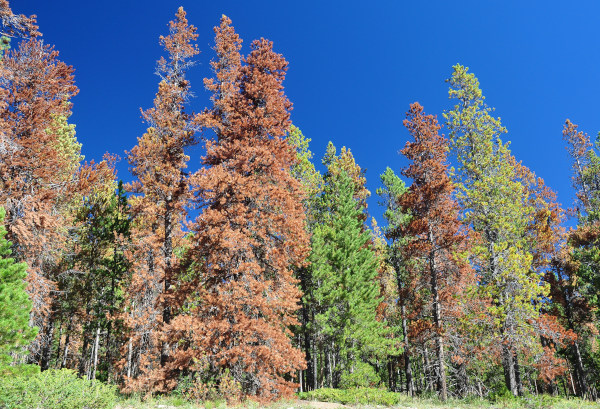
Fading or Discoloring Needles
Healthy green needles that turn yellowish, then rusty red. By the time an entire crown is red, the beetles have typically already exited the tree and moved to new hosts.
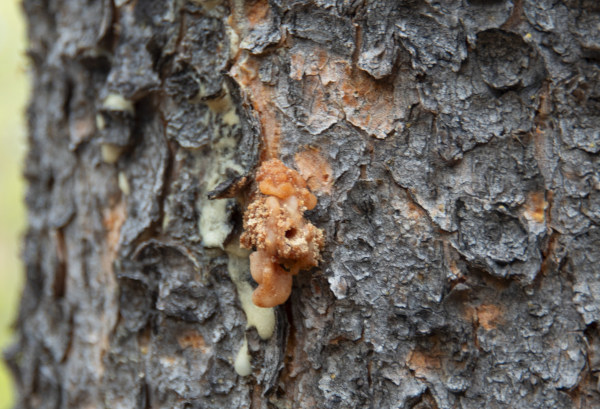
Pitch Tubes on the Trunk
Small, popcorn-shaped masses of resin on the bark surface. These form when the tree tries to "pitch out" boring beetles. Reddish-brown pitch tubes indicate a failed defense.
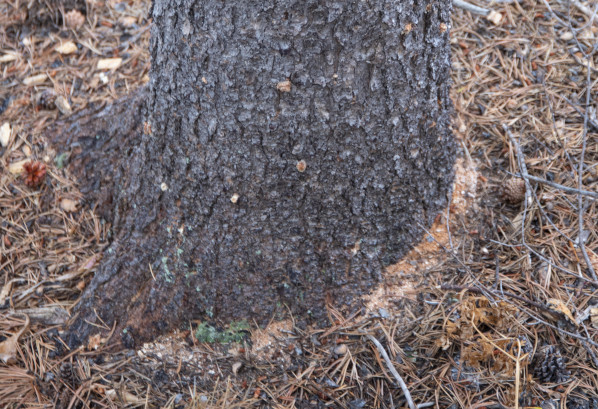
Boring Dust (Frass)
Fine, reddish-brown sawdust accumulating in bark crevices, around the base of the tree, and on spider webs nearby. This indicates active beetle tunneling beneath the bark.
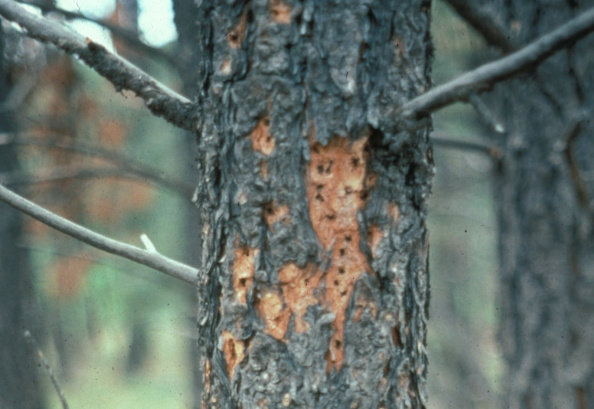
Woodpecker Activity
Heavy woodpecker feeding on trunk and branches strips bark as they search for beetle larvae. Large patches of light-colored, exposed wood are a telltale sign of severe infestation.
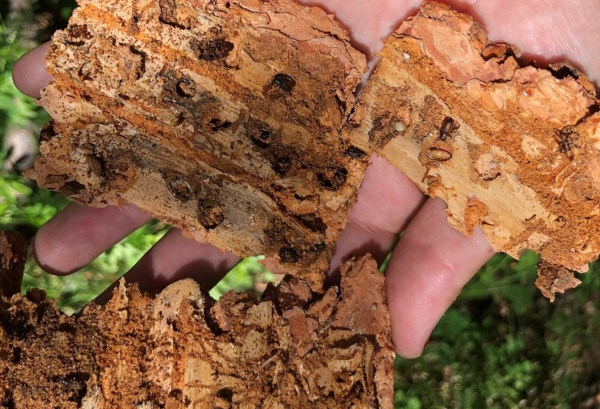
J-Shaped Galleries Under Bark
Peel back a small section of loose bark to reveal tunneling patterns. Mountain pine beetles create distinctive J- or Y-shaped egg galleries carved into the inner bark.
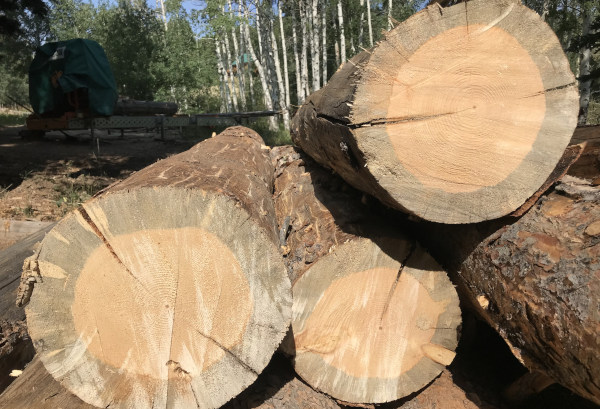
Blue Stain Fungus
Beetles carry blue stain fungus that blocks the tree's water-conducting tissues. Cross-cut sections of affected wood show distinctive blue-gray streaking through the sapwood.
Photos: Colorado State Forest Service
Nearby Front Range Communities
Latest from the Blog
View All →
Colorado's 2026 Pine Beetle Response: Task Force, Funding, and What It Means for Homeowners
Governor Polis created a statewide task force, Jefferson County launched a $500K cost-share program, and the legislature is funding biological controls. Here's what Colorado is actually doing about the pine beetle outbreak — and what homeowners need to know.

Colorado's Ponderosa Mountain Pine Beetle Task Force: What It Is, Who's Behind It, and What It Means for the Front Range
Colorado's Ponderosa Mountain Pine Beetle Task Force was created to fight the expanding Front Range outbreak. Here's what the task force is doing and what it means for you.