
Pine Beetle Prevention in Woodland Park, Colorado
Protect your trees from bark beetle infestations in Woodland Park, Teller County. Local prevention tips, risk assessment, and professional resources.
Elevation
8,465'
Population
8,268
County
Teller
Primary Trees
Ponderosa Pine, Lodgepole Pine
CSFS Mountain Pine Beetle Activity — Teller County
Documented
Active beetles in county
Adjacent
Nearby activity
Not Documented
No confirmed activity
Source: Colorado State Forest Service aerial surveys, 2024
Mountain Pine Beetle in Teller County
Teller County experienced devastating MPB impacts during the 2006-2013 epidemic that killed an estimated 70% of mature lodgepole pine. Current activity targets the county's lower-elevation ponderosa pine stands.
Teller County Details
Commissioner Dan Williams (Cripple Creek) represents Teller County on the state Pine Beetle Task Force. The county has hard-won experience from the previous epidemic and established relationships with CUSP (Coalition for the Upper South Platte) for forest health management.
Key Finding
70% of mature lodgepole pine killed in 2006-2013 epidemic; new threat to ponderosa
Front Range Outbreak Trend
Acres of MPB-caused tree mortality, Front Range. Source: CSFS Aerial Surveys, 2020–2024
700K+
Acres of vulnerable pine along the Front Range
1,767%
Increase in affected acres, 2020–2024
Data sourced from Colorado State Forest Service aerial survey reports, forest health publications, and local reporting.
Pine Beetle Guide for Woodland Park, Colorado
Woodland Park is a mountain community of roughly 8,268 residents in Teller County, perched at 8,465 feet on the west slope of Pikes Peak along the Ute Pass corridor. Known as the "City Above the Clouds," Woodland Park sits at the highest elevation of any incorporated city along Colorado's Front Range and serves as the gateway between the Pikes Peak region and the high mountain parks of central Colorado. The town's landscape is dominated by a mixed conifer forest of Ponderosa Pine and Lodgepole Pine — a dual host environment that makes Woodland Park uniquely vulnerable to bark beetle outbreaks. Rampart Reservoir, Mueller State Park, and the vast expanse of Pike National Forest surround the community, creating a setting of extraordinary natural beauty and exceptional beetle risk.
Pine Beetle Risk in Woodland Park
Woodland Park holds a Critical pine beetle risk designation, and among Front Range communities, its combination of extreme elevation, dual pine species, and national forest encirclement creates arguably the most challenging beetle management environment in the region.
At 8,465 feet, Woodland Park sits at the upper end of the mountain pine beetle's primary activity zone in Colorado. This elevation produces cold winters that historically limited beetle survival — sustained temperatures below minus 30 degrees Fahrenheit kill overwintering larvae. However, Woodland Park has not recorded that extreme cold consistently in recent winters, and the warming trend has allowed beetle populations to maintain and build at this altitude.
The defining feature of Woodland Park's beetle risk is its dual pine species composition. The town's lower-elevation southern and eastern neighborhoods, including the Painted Rocks and Midland areas, are dominated by Ponderosa Pine. As elevation increases toward the north and west — toward Divide and the Rampart Range — the forest transitions to Lodgepole Pine and mixed Ponderosa-Lodgepole stands. Mountain pine beetles are equally effective in both species, and the continuous forest of mixed pines provides an unbroken landscape of host trees that supports large beetle populations.
Woodland Park's historical beetle experience is well documented and traumatic. During the 2006-2013 mountain pine beetle epidemic — the largest bark beetle outbreak in Colorado's recorded history — Teller County lost an estimated 70 percent of its mature Lodgepole Pine stands in some areas. The forests surrounding Rampart Reservoir and along Teller County Road 1 (Rampart Range Road) were devastated, with entire hillsides turning from green to red to gray. Woodland Park's Ponderosa Pine suffered less severe but still significant losses. The standing dead timber from that epidemic continues to affect the community through wildfire risk and ongoing beetle habitat.
Pike National Forest completely surrounds Woodland Park, and the town's development pattern — a mix of mountain subdivisions, small acreages, and commercial corridors — is interwoven with forest land. There is no meaningful separation between community and forest. Beetles moving through the national forest encounter residential trees seamlessly.
Prevention Tips for Woodland Park Properties
Woodland Park requires the most intensive and sustained prevention program of any Front Range community, reflecting its extreme risk environment.
Dual-Species Thinning Strategy: If your property contains both Ponderosa and Lodgepole Pine, develop a thinning plan that addresses each species' needs separately. Ponderosa stands should be thinned to approximately 50 trees per acre. Lodgepole tolerates and benefits from slightly higher densities — target 60 to 80 trees per acre. In mixed stands, favor retaining Ponderosa over Lodgepole where both are present. Ponderosa is more drought-tolerant, produces more defensive pitch, and develops thicker bark that slows beetle boring — making it more resilient to beetle attack than Lodgepole of similar size. Remove all standing dead timber from the 2006-2013 epidemic that remains on your property. While this dead wood no longer produces beetles, it is a serious wildfire fuel hazard.
Extended Dormant-Season Watering: Woodland Park's growing season is shorter than lower-elevation communities, but its drought stress period can be just as long. Begin supplemental watering in October and continue through May — a seven-month program that maintains tree moisture reserves through both winter drought and the critical spring period before beetle flight. Focus on the 10 to 20 highest-value trees within 50 feet of structures. The town's water comes from a combination of wells and surface sources; contact the Woodland Park Water Department for current drought guidelines. At Woodland Park's elevation, delivering 12 to 15 gallons per inch of trunk diameter monthly via soaker hose at the drip line provides adequate supplementation for most years.
Altitude-Adjusted Spray Timing: Woodland Park's higher elevation pushes beetle flight season later than lower communities. Preventive bark sprays should be applied between late April and mid-June — the window is wider here than at lower elevations because beetle emergence occurs later. Apply carbaryl-based products to Ponderosa Pine trunks from ground level to live crown base. For Lodgepole Pine, bark sprays are less effective because the thinner bark absorbs and retains less product. Consider systemic trunk injections with emamectin benzoate as an alternative for valued Lodgepole specimens, though this approach is still being evaluated for bark beetle efficacy.
Firewood Protocol at Altitude: Many Woodland Park residents depend on wood heat and harvest firewood from their properties and national forest woodcutting areas. This creates a direct beetle introduction pathway. Process and split all firewood immediately after cutting — do not leave log-length rounds on-site during warm months. Store split wood under clear plastic tarps from April through September. Beetle larvae cannot survive in fully dried, well-seasoned wood, so the goal is rapid drying through prompt splitting and air exposure. Wood brought from off-property should be tarped immediately regardless of season — you may be importing beetles from another infestation.
Fire District Coordination as Beetle Strategy: Woodland Park is served by the Woodland Park Fire Department, and the surrounding Teller County fire districts all recognize that beetle management and wildfire preparedness are the same mission. Participate in community thinning programs, coordinate with neighbors on treatment timing, and engage with the Coalition for the Upper South Platte (CUSP), which has been instrumental in coordinating landscape-scale forest health work in the Woodland Park area. The Ute Pass fuels mitigation collaborative provides another avenue for regional coordination.
Local Resources
- Teller County Forestry Program provides property assessments and coordinates county-wide beetle monitoring and forest health initiatives. Their foresters understand the unique challenges of Woodland Park's mixed Ponderosa-Lodgepole environment.
- Woodland Park Fire Department and surrounding Teller County Fire Districts offer defensible space assessments that fully integrate beetle management with wildfire preparedness — the two are inseparable at this elevation.
- Coalition for the Upper South Platte (CUSP) coordinates watershed and forest health projects throughout the Woodland Park area, including community thinning, slash removal, and education programs. They have been a critical partner in post-epidemic recovery work.
- Pike National Forest — Pikes Peak Ranger District and South Park Ranger District manage the federal forests surrounding Woodland Park and can provide current beetle condition reports for the public lands adjacent to your property.
- Mueller State Park (south of Woodland Park) monitors beetle conditions within the park and offers educational programs about bark beetle ecology. Their observation data provides context for what is happening in the broader forest.
- Colorado State Forest Service provides technical assistance, beetle species identification, and cost-sharing programs for Teller County landowners managing private forest land.
Nearby Affected Areas
Woodland Park is at the center of the most severe beetle-affected zone on the Front Range. To the east, Colorado Springs faces High risk in its western foothills, with beetle populations dispersing downslope from the Ute Pass corridor. Monument and Palmer Lake to the northeast share Critical risk ratings on the Palmer Divide. The town of Divide to the west and Cripple Creek to the south have experienced devastating Lodgepole Pine losses from the same epidemic that hit Woodland Park. Pike National Forest, which surrounds the community on all sides, continues to harbor significant beetle populations that periodically erupt when conditions favor outbreaks. Evergreen and Conifer in Jefferson County face similar challenges with mixed Ponderosa-Lodgepole forests at comparable elevations.
Common Pine Beetle Species in Colorado
Three bark beetle species pose the greatest threat to pine trees in Woodland Park and across Colorado's Front Range.
Mountain Pine Beetle
Dendroctonus ponderosae
The primary killer of Ponderosa and Lodgepole pines along the Front Range. Adults are black, about the size of a grain of rice (5mm). They use aggregation pheromones to coordinate mass attacks that overwhelm a tree's pitch defenses.
- ● Targets trees 8"+ diameter
- ● One generation per year (July–August flight)
- ● Carries blue stain fungus that blocks water transport
- ● Creates J-shaped egg galleries under bark
Ips Engraver Beetle
Ips pini
A smaller, opportunistic beetle that exploits any weakness: drought stress, pruning wounds, fresh slash piles, or construction damage to roots. Less dramatic than MPB but persistent and hard to prevent entirely.
- ● Attacks trees of any size, including limbs
- ● 2–3 generations per year (April–October)
- ● Creates Y-shaped egg galleries under bark
- ● Often the first beetle to attack stressed trees
Red Turpentine Beetle
Dendroctonus valens
The largest bark beetle in North America (up to 10mm). Typically attacks the lower trunk of weakened or injured trees. Rarely kills trees on its own but signals stress that can attract MPB and Ips beetles.
- ● Attacks lower 6 feet of trunk
- ● Produces large, quarter-sized pitch tubes
- ● Indicator species for tree stress
- ● Often found after construction or root damage
Species data: Colorado State Forest Service, USDA Forest Service
Signs of Pine Beetle Infestation
Knowing what to look for is the first step to protecting your Woodland Park property. Here are the key warning signs every homeowner should monitor.
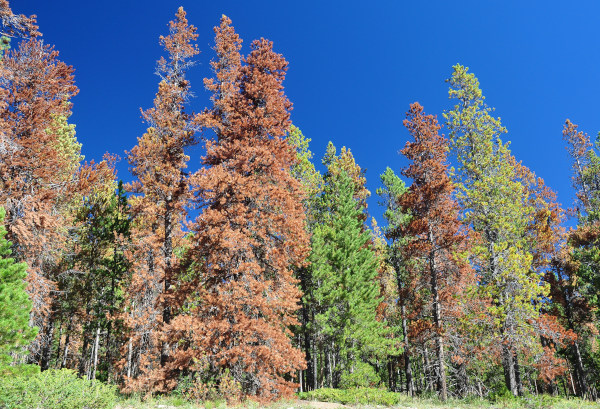
Fading or Discoloring Needles
Healthy green needles that turn yellowish, then rusty red. By the time an entire crown is red, the beetles have typically already exited the tree and moved to new hosts.
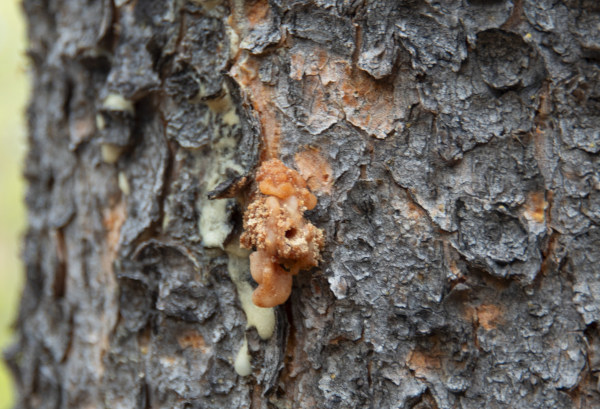
Pitch Tubes on the Trunk
Small, popcorn-shaped masses of resin on the bark surface. These form when the tree tries to "pitch out" boring beetles. Reddish-brown pitch tubes indicate a failed defense.
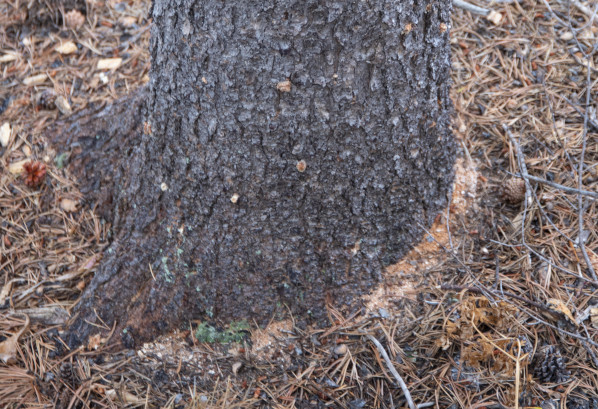
Boring Dust (Frass)
Fine, reddish-brown sawdust accumulating in bark crevices, around the base of the tree, and on spider webs nearby. This indicates active beetle tunneling beneath the bark.
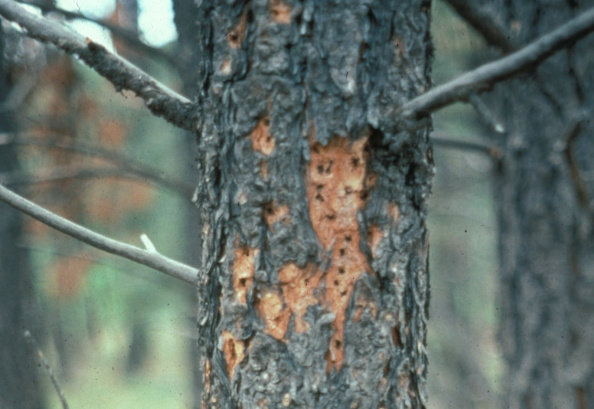
Woodpecker Activity
Heavy woodpecker feeding on trunk and branches strips bark as they search for beetle larvae. Large patches of light-colored, exposed wood are a telltale sign of severe infestation.
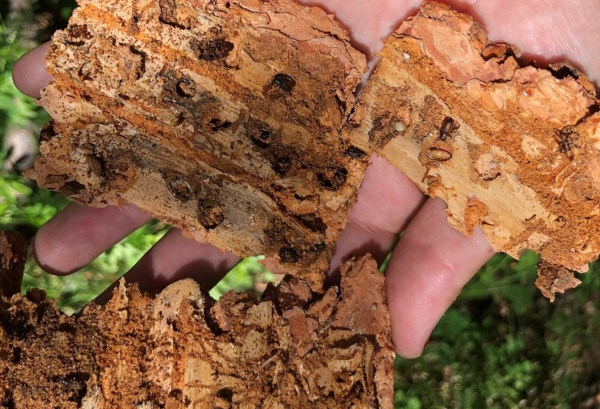
J-Shaped Galleries Under Bark
Peel back a small section of loose bark to reveal tunneling patterns. Mountain pine beetles create distinctive J- or Y-shaped egg galleries carved into the inner bark.
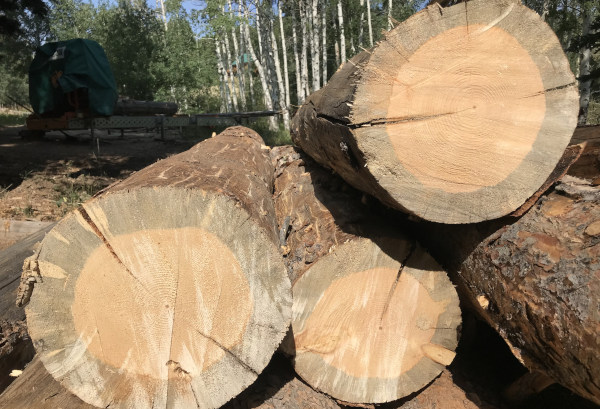
Blue Stain Fungus
Beetles carry blue stain fungus that blocks the tree's water-conducting tissues. Cross-cut sections of affected wood show distinctive blue-gray streaking through the sapwood.
Photos: Colorado State Forest Service
Latest from the Blog
View All →
Colorado's 2026 Pine Beetle Response: Task Force, Funding, and What It Means for Homeowners
Governor Polis created a statewide task force, Jefferson County launched a $500K cost-share program, and the legislature is funding biological controls. Here's what Colorado is actually doing about the pine beetle outbreak — and what homeowners need to know.

Colorado's Ponderosa Mountain Pine Beetle Task Force: What It Is, Who's Behind It, and What It Means for the Front Range
Colorado's Ponderosa Mountain Pine Beetle Task Force was created to fight the expanding Front Range outbreak. Here's what the task force is doing and what it means for you.